

Gradually, my plan emerged. I would follow the spirit of Peter's tour through the highlands to Cape Wrath, and accommodate my time constraints by starting, not in Glasgow, but in Inverness, the “capital of the highlands”. This would also enable me to avoid the busier roads around Glasgow and Edinburgh.
An EasyJet flight from the South of England to Glasgow (£10 extra for the bike), was followed by a hurried stop at a friend's house in Paisley where I assembled my Bike Friday, packed my panniers, and deposited my bike's suitcase for the duration. I was soon on a late morning train to Inverness. Late was the word: the train missed its connection in Perth by two minutes, and Scotrail had a dozen of us driven from Perth to Inverness in a fleet of Taxis! If my bike had not been capable of being folded into the back of the Taxi, I'm not clear what they would have done for me.

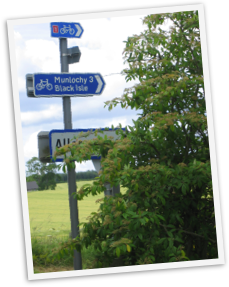


NCN 1 (National Cycle Network Route 1) heads North from Inverness across the Kessock Bridge and through a complex network of narrow lanes. My legs were stiff from the taxi ride; the wind was full in my face, and the route seemed to have been devised by a drunken Scottish shepherd taking a random walk. Eventually I reached Connan Bridge, and then Dingwall, which is now the site of an enormous Tesco Superstore than seems to feed most of the highlands of Scotland.
Here I caught up with Peter's spirit; I fancy that he also found the back lane that parallels the A862 from Dingwall to
Evanton, that he also smelled the woods on his left and looked out over Cromarty Firth on his right. It's not just fancy that leads me to guess that Peter also had the wind at his back and flew along, eating up the undulating miles, for this route was part of a long day that had started for him much further south, at a campsite near Drumnadrochit, close by Loch Ness.
My destination for the night was a wonderful B&B in Stittenham, right on the A836 where it climbs out from Alness “up and over to Bonar Bridge”, a road that the locals call “the Struie”. I know that Peter took the same road, and covered 109 miles that day before eventually finding a campsite on the shores of Loch Stack. He wrote “perhaps that sounds rather a long ride; it was in fact longer than intended, for the last 15 miles were spent looking for a camp site.” Peter’s log also told me that he had, with commendable foresight, shopped for dinner in Inverness — there having been no place to buy provisions for the last 50 miles of his ride.
The following morning, fortified by porridge and eggs and starting off half way up the Struie, I made short work of the rest of the climb and was soon enjoying a sweeping descent back to the tidewater of Dornoch Firth, and thence by Carbisdale Castle to Lairg. Forewarned about the shortage of provisions, I had eaten a cheese toastie in Lairg, and 35 miles later as I tried to spot Peter's campsite by Loch Stack, I was promising myself fish and chips in Laxford Bridge.
Here I learned an important lesson in Highland geography: a name on the map does not a town make. There is no chip shop in Laxford Bridge, nor any other kind of shop, nor a cafe, nor, as far as I could see, a house. All that is there is... a bridge.
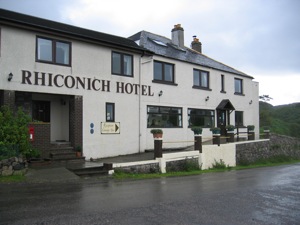
Five wet miles further up the road, I walked into the Richonich Hotel ready for some serious lunch. I was immediately greeted, and offered... coffee. I replied that what I would really like was something to eat — and was told that the kitchen was closed until dinner time.
Eventually, sustained by tea, scones, every morsel of butter and jam that I could scrape out of the pots, cake, and conversation with a pleasant couple staying at the hotel, I was ready to tackle the last 15 miles to Durness, where a bed was waiting for me at the Lazy Crofter Bunkhouse.
Peter had cycled from his camp on Lock Stack to Cape Wrath, the most North-westerly point on the British Mainland, and had then ended his day at a campsite in Durness. I planned to stay at the Bunkhouse for two nights, and take a full day to visit Cape Wrath and explore the area.
I’m not really sure why Cape Wrath became destination for cyclists, but it has been one at least since 1949, when cycling journalist Rex Coley founded the Cape Wrath Fellowship. I believe that Peter Knottley was also secretary of the Cape Wrath Fellowship at some time, but don't know the details. Perhaps the magic of the Cape comes from the 11 miles of road from Keoldale to Cape Wrath, which can be accessed only by a passenger ferry, and are thus inaccessible to motorists. Nowadays a minibus service carries tourists from the ferry to the cape, but when I arrived at the cape on my bike, the minibus was just leaving, and I had the place to myself. In the past the lighthouse keeper would take photographs of visiting cyclists, but now the lighthouse is automated, and I was alone with the birds and the swirling mist.
Those eleven miles across the Cape are some of the worst miles dignified by the name "road" that I have ever ridden. Two wheel ruts paved with disintegrating tar and packed stone zig-zag across the headland, dipping to cross three valleys and an MOD firing range, and requiring in places mountain bike handling skills. The 28mm tires and the suspension beam on my Air Friday made it all ridable, but a mountain bike with fat tires would have made it a lot more fun.
I was back at the ferry dock quite early, but had to wait over an hour for the next minibus to arrive before the ferry operator would come and pick me up. I rounded out the day with a visit to Balnakeell Beach and Craft Village, a tour of Smoo Cave just east of Durness, and a truly gargantuan meal that I cooked for myself at the bunkhouse. Fortunately for me, I was saved from the sin of gluttony by the arrival of two women from Korea after the Durness shop had closed for the day: I was able to convince them to eat my excess food rather than going hungry.
< Previous --- Next >



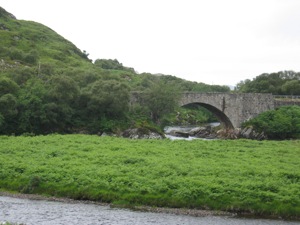

The bridge at Laxford
The Rhiconich Hotel
There are few houses and fewer shops in the north of Scotland, but there are occasional hotels… They seem quite accustomed to receiving bedraggled cyclists and provide hot drinks and food at all hours of the day. Such an hotel was at Rhiconich, 14 miles from Durness.
Peter Knottly, Cycletouring in Europe
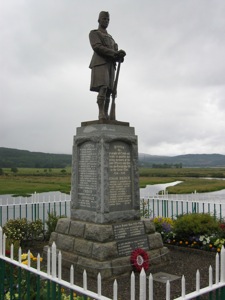
War memorial, Bonar Bridge

