in Advances in Filtration and Separation Technology, Volume 13a, eds. W. Leung and T. Ptak, American Filtration and Separations Society, pp. 219-226 (1999).
STORMWATER PARTICLE REMOVAL USING A CROSS-FLOW FILTRATION AND SEDIMENTATION DEVICE
Tracy S. Schwarz and Scott A. Wells
Graduate Research Assistant and Professor, respectively
Department of Civil Engineering
Portland State University
PO Box 751
Portland, OR 97207-0751 Voice(503) 725-4282 FAX (503)725-5950
ABSTRACT
Capture of stormwater particulate matter is of concern to watershed managers trying to meet water quality guidelines by removing toxics associated with particulates from natural water bodies. A laboratory investigation into particle removal efficiency of a prototype Continuous Deflective Separation (CDS) device was made in the laboratory. Particle size distributions were obtained for roadway drainage surfaces. These distributions were used to assess the predicted performance of a CDS unit in the field. Flow rates in the laboratory tests ranged from 125 GPM (7.9 l/s) to 270 GPM (17.0 l/s). Screen sizes used for testing were 1200 μm and 2400 μm. Using four different sand types and the two screen sizes, particle capture rates were determined for the CDS unit.
Internal velocities were measured at seventy-two measuring positions within the main chamber of the CDS unit. At 270 GPM capture rates based on particle size ranged from 12% to 100% with the 2400 μm screen, and 22% to 100% with the 1200 μm screen. Cumulative mass capture rates were 73% and 70% for the 1200 μm and 2400 μm screens, respectively, at 270 gpm and 84% at 125 gpm for the given particle distribution used.
INTRODUCTION
Appearing to have similar features to the vortex separator introduced in the U.S. during the 70’s, the Continuous Deflective Separation (CDS) mechanism introduces a filtration mechanism for solid separation. The filtration mechanism, when combined with circular flow action and particle sedimentation, increases removal rates beyond vortex separators during times of high flows. The CDS unit works by deflecting the inflow and associated pollutants away from the main flow stream into a separation chamber. The chamber has a sump at the bottom and a screen in the upper section. The screen acts to remove the gross pollutants allowing the filtered water to pass through to a return system. While in the chamber, the floatable solids are kept in continuous motion on the water surface by the incoming flow. This keeps the solids in the chamber from blocking the screen. The heavy solids settle to the bottom of the sump. This unit acts as a continuous cleaning unit, since the solids do not become imbeded in the filter screen as in a direct screening situation.
BACKGROUND
During recent times water quality has become an important issue, as federal government, communities, and citizen groups have sought to clean up Americas waters. One concern is the growing problem with non-point source pollution in the form of storm drainage from roadways. Thomson et al. (1997) cites that pollutants such as lead, zinc, copper, chromium, iron, and phosphorus attach to Suspended Solids (SS) and are transported over roadways to storm drains. These pollutants come from sources such as tire wear, brake linings, and leakage of oil, pavement wear, application of de-icing compounds, pesticides and herbicides, accidental spills, tree leaves, and littering. The solids come from the fine particulate dust of the surrounding areas, dust and dirt transported and blown about by vehicular traffic, and the de-icing agents - namely sand/salt mixtures (Thomson et al. 1997).
The sources of heavy metals vary. Lead is primarily from tailpipe emissions (Christensen and Guinn, 1979). It is usually associated with the finer particulates (Hopke et al. 1980). With the prohibition of lead based petroleum products in many parts of North America, this is a diminishing issue. Zinc primarily comes from the wear of tires (Christensen and Guinn, 1979) and to a much smaller degree, from brake linings, exhaust emissions, and salting (Hopke et al. 1980). Metals such as iron, barium and cesium also come from brake linings (Hopke et al. 1980).
Particle Distribution
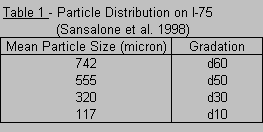
The sizes of particles on roadways are of great importance in design for solids’ removal. Sansalone et al. (1998) performed particle studies on I-75 in Cincinnati, Ohio. They found solids ranging in size from smaller than 1 micron to greater than 10,000 micron. A mechanical sieve apparatus was used to determine particle distribution by mass. Sansalone et. al. (1998) found the 425 to 850 µm range had the highest total surface area for all the storm events tested. The majority of the particle counts were in the range of 2 to 8 µm. These 2 - 8 µm particles are typically "first flushed" from the roadway surface during the onset of a storm. The term "first flushed" refers to the time period early in the rainfall hydrograph during which the accumulated surface particles are removed. At time periods following the first flush, only the recent particle deposits are present in the stormwater (Sansalone et al. 1998). The mean particle size distribution based on 13 events during 1996 and 1997 from the Sansalone et al. (1998) work is shown in Table 1.
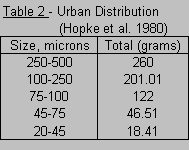
Hopke et al. (1980) performed a particle analysis in Urbana, Illinois. Particle sample collections were made in a moderately sized, non-industrial, urban community. Samples were collected by vacuuming the gutter and roadways of two moderately traveled (» 7000 cars/day) intersections. Hopke et al. (1980) suggest the range of SS is from less than 20 µm to over 500 µm. The particle distribution Hopke et al. (1980) found is shown in Table 2.
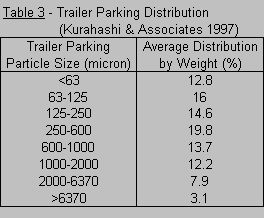
Kurahashi & Associates performed a stormwater evaluation for the Port of Seattle in 1997. The study area was at one of the Port’s existing container storage yards. Samples were collected from the trailer parking area. The surface area where samples were collected was about 2000 square feet in size. Hand sweeping and mechanical vacuuming procedures were used on the dry pavement to collect the samples. From this area between May 31, 1996 to July 30, 1996 the particle size ranges and distributions determined are shown in Table 3. Analysis was done using a mechanical sieve.
Removal Methods
In an attempt to remove pollutants from runoff, a variety of methods have been used. Some methods to prevent pollutants from entering surface waters are infiltration trenches, detention basins, retention basins, vegetated swales, and wetlands. These can remove a lot of the SS and the associated pollutants. All of these options require surface area that is not always available.
Minton et al. (1996) did a study of the performance of vegetated swales. In his study he determined removal rates of 60%-83% SS for four different swales tested in the Seattle, WA area. Minton et al. (1996) claims that values for mean removal can be misleading as the range of individual storm removal rates can be very large.
Other removal methods include wet wells and street sweeping. These methods are either labor intensive, maintenance intensive or both. Street sweepers remove particles greater then 250 microns very well (84-96% capture), but for smaller sizes they are less effective (Kurahashi & Associates, Inc. 1997). A benefit to street sweepers is that they are capable of removing dissolved pollutants that other pollutant removers cannot. Street sweepers are limited in that they are only effective during dry seasons (Kurahashi & Associates, Inc. 1997). Wet wells remove only sediment and associated particulate pollutants. Since they capture particles during runoff, the pollutants in the form of dissolved solids escape. They have a removal efficiency of 90% for SS (Kurahashi & Associates, Inc. 1997).
The vortex separator is a below ground removal method. One such separator is used in Tengen Germany. It is called the Fluidsep (Pisano and Brombach, 1994). This separator was intended for use in removing settleable solids and floatables from combined sewer overflows. The design flow for the Fluidsep vortex separator is 950 L/s. The unit was tested in four storm events. Removal efficiencies for total solids typically range from 72% to 80% (Brombach et al. 1993), though events have been recorded with total solids removals from 32% to 91% (Pisano and Brombach, 1994). Particle analysis for the vortex separator shows efficient separation for particles with a diameter greater then 30 µm (Brombach et al. 1993). This process grows more ineffective as the flow increases. This ineffectiveness is caused by the uplift pressures on the solids overcoming the effect of downward pressures due to the secondary current. This problem is eliminated using the filtration mechanism found in a Continuous Deflective Separation system (Wong et al. 1996).
The Continuous Deflective Separation (CDS) mechanism is one of the new methods for removing SS from surface runoff. Previous research has focused on varying screen sizing, inflow velocity, and percentages of outflow from the bottom of the sump (Wong et al. 1996, Wong et al. 1997). Screen sizing has been determined to have a significant influence on the sediment trapping efficiency of the CDS unit.
Tests were carried out by Wong et al. (1996) to determine the efficiency of the CDS unit. Six groups of sand grades were made by sieving a range of graded mineral sands. The graded diameters ranged from 200 µm to 780 µm. Using a minimum 3700 µm aperture size, capture of SS was 90% for a 900 µm particle (25% of the minimum aperture size), and 50% for a 500 µm particle (12.5% of the screen aperture size).
SEPARATION EFFECTIVNESS OF THE CDS UNIT
Laboratory
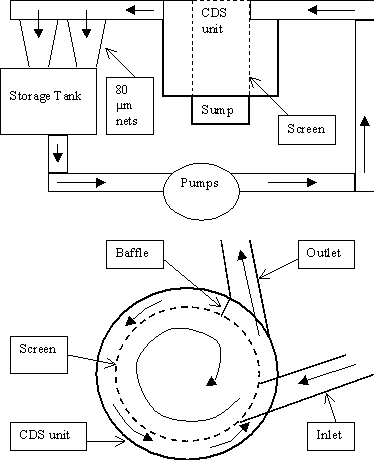
Using an existing storage tank and pumps, a flume intended for hydraulic modeling was modified to circulate water through the CDS unit. Six-inch diameter PVC pipe was used as the inlet and outlet to the CDS unit. A sketch of the CDS unit is shown in Figure 1. Particles are added to the flow as the water passes through the stainless-steel rectangular inlet. This area is ideal for the addition of particles since the enlargement of the channel creates additional mixing. As water exits the CDS unit and before it is recirculated to the CDS unit, a filter captures particles that are not captured by the CDS unit. The filter is composed of four 80 μm plankton nets hanging from the outlet pipe. After the water passes through the filter, it is returned to the storage tank. This laboratory system currently allows for a maximum flow of 270 GPM. The three 121 GPM pumps have two speed settings allowing for a variety of flow rates less than 270 GPM.
Internal Velocities in the CDS Unit
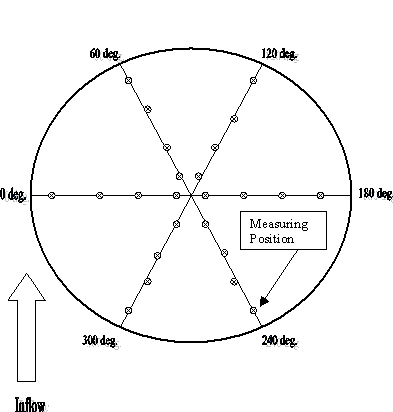
Internal velocities were of interest in analyzing the particle dynamics in the main chamber of the CDS unit. Using a velocity meter, Marsh-McBirney, Inc. Model 511, the two-dimensional internal velocities were recorded horizontally in the main chamber. Figure 2 depicts the 24 measuring positions used at each of three depths. The measurements were taken at 8.5 inches (21.6 cm) and 16.5 inches (41.9 cm) from the bottom of the screen, and the final measurements were taken level with the bottom of the inlet port.
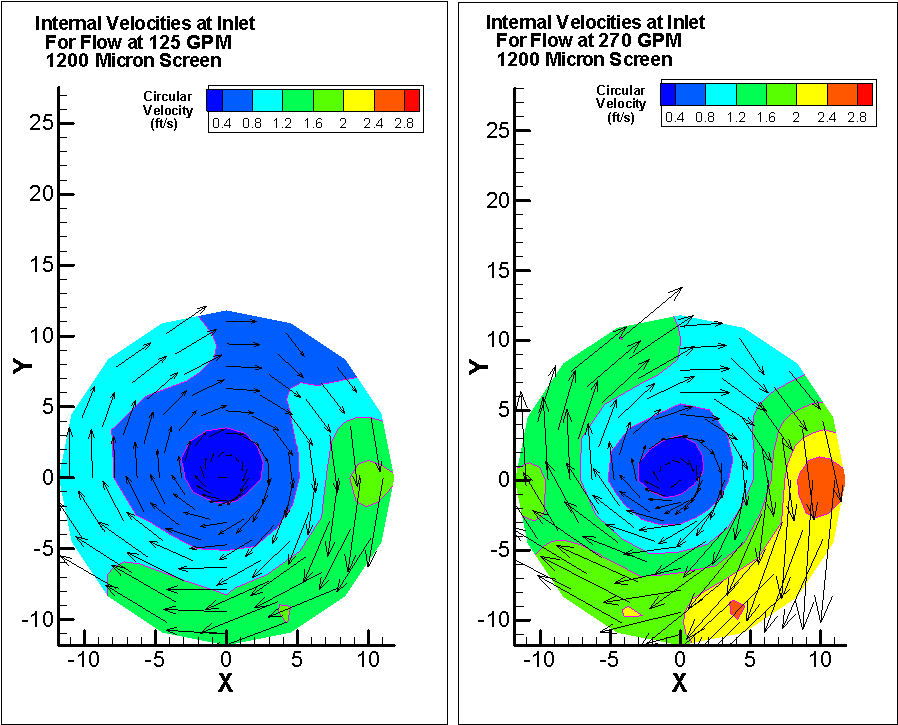
When determining the internal velocities for the 1200 µm and 2400 µm screens, the 270 GPM and 125 GPM flow rates were used. Internal velocities were found to be either the same or somewhat higher when using the larger screen. Velocities ranged from 0 to 3.15 ft/s (96 cm/s) for both the 1200 µm and 2400 µm screens. Figure 3 shows velocities in the CDS unit at the vertical level of the inlet. (The inlet is located at X= +11.8 inches and Y=0 inches.)
Methods of Trapping and Analysis
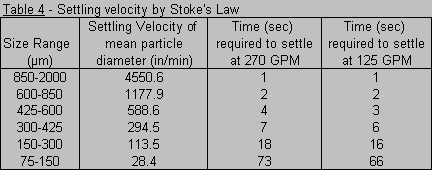
Detention time was determined for the CDS unit. The CDS unit was divided up into two separate areas; an active area that existed above the bottom of the screen, and an inactive area below the bottom of the screen. The inactive area is that which only serves as an accumulation area for particles. The active volume of water in the CDS unit varies depending on the flow rate. At 270 GPM the volume in the CDS unit is 97.0 gallons (367.2 L) corresponding to a depth of 34.5 inches (87.6 cm), with a detention time of 22 seconds. At 125 GPM the volume in the CDS unit is 90.4 gallons (342.2 L) corresponding to a depth of 31 inches (78.7 cm), with a detention time of 43 seconds. Using Stoke’s Law and an assumed value of specific gravity for silica, 2.66, the settling velocities for each size range were computed in Table 4. This information was used to determine if a given particle range will settle to the sump during operation of the CDS unit.
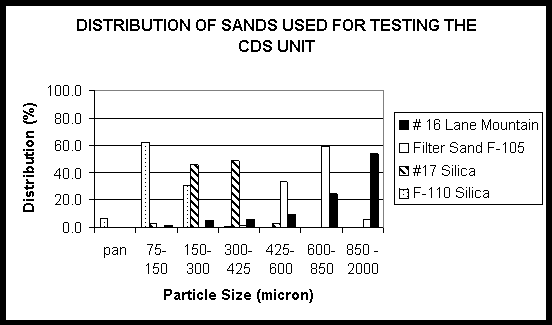
Four different sand types were obtained. These sands were graded into six size divisions using a mechanical sieve. All sands are Silica sands. The results are shown in Figure 4. Each sand type has a particular range that the majority of the weight in the distribution resides.
Following the work of Wong et. al. (1996) 10 kg was chosen as the amount of sand to input into the CDS unit for testing. A funnel delivered the 10 kg of sand in 17-25 minutes, depending on the type of sand used. Sand was delivered to the CDS unit through a port in the inlet structure eight inches (20 cm) from the chamber.
After all the sand cleared the input port on the CDS unit, the pumps were allowed to run an additional 10 minutes to allow all particles time to make their way to the plankton nets. The nets were then removed and the particles passing the CDS unit were placed in glass beakers. The beakers were placed in a convection oven at 50ºC until all the water evaporated.
Each sample passing the CDS unit was graded using the same screens and mechanical sieve as for the original distributions. Using the distribution weights obtained from the first distribution and those of the particles passing the CDS unit, the percent capture was determined for each size distribution of each sample tested. The following equation was used to determine percent captured by the CDS unit:
Capture rate = 1 – (Wt. of Distribution Passing CDS unit / Wt. of Original Distribution) (1)
Testing was performed using each of the four sand types with the 1200 µm and 2400 µm screens. Two different flow rates, 270 GPM and 125 GPM, were chosen as representative of the range of flow rates that would enter the CDS unit.
RESULTS
Results: Sediment Trapping Efficiencies – 1200 µm Screen
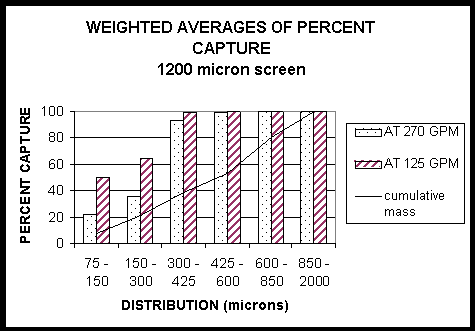
Using the 1200 µm screen, the rate of capture was found to decrease with decreasing particle size for all sands tested. The weighted average of all the types of sand used is shown in Figure 5. This figure incorporates the effect of particles passing the CDS unit combined with other particles of varying distributions. Since the 1200 µm screen has openings larger then the largest particle, all particles tested were capable of passing through the screen. The poorest capture rate of the CDS unit was 22% for the 75-150 µm particles flowing at 270 GPM. The overall mass capture rate was 73% and 84% for 270 GPM and 125 GPM, respectively.
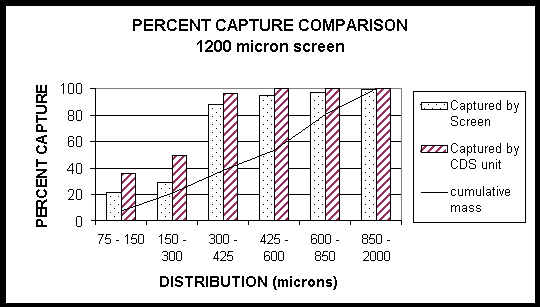
The CDS unit was disassembled following the input of 80 kg of particles. The particles represented 20 kg of each of the four sands tested. The material accumulated between the screen and the chamber wall weighted 7.3 kg. This represented 9.2% of the particles put into the unit for the series of testing. The difference this percentage made upon capture can be seen in Figure 6 for the composite of the 125 GPM and 270 GPM flow rates. In Figure 6, "Captured by Screen" includes only particles captured within the CDS unit, and "Captured by CDS unit" includes particles captured within CDS unit and particles that settled outside the screen in the outlet channel.
Results: Sediment Trapping Efficiencies – 2400 µm Screen
The capture rates for the 2400 μ
m screen were lower for smaller particles and better for larger particles. Figure 7 shows the percent capture of the weighted average of all the types of sands used. This figure incorporates the effect of particles passing the CDS unit combined with other particles of varying distributions. Since the screen used was a 2400 µm screen, all particles were capable of passing through the openings in the screening. The poorest capture rate of the CDS unit was 12% for the 75-150 µm particles flowing at 270 GPM. The overall mass capture rate was 70% and 84% for the 270 GPM and 125 GPM, respectively.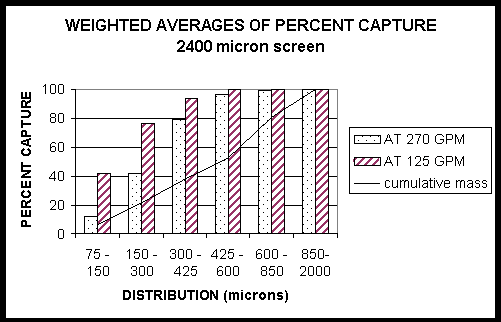
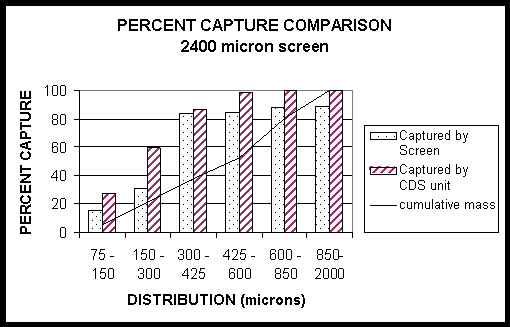
The CDS unit was disassembled following the input of 80 kg of particles evenly divided between the #17 silica, Filter Sand, and Lane Mountain sand. There was nearly 13 kg of particles found between the screen and the outer chamber wall. This represented 16.3% of the particles put into the unit for the series of testing. Figure 8 contrasts percent particle capture between particles caught in the sump and particles captured both in the sump areas and in the outlet channel.
CONCLUSIONS
In the laboratory setting we tested a cross-flow filtration device with flow rates between 125 GPM and 270 GPM. Two different screen sizes 1200 μm and 2400 μm were used. Removal efficiencies were excellent for particles greater than 425 µm, having capture rates near 100%. For particles less than 300 µm, dramatic decreases in particle removal efficiency were seen. Removal efficiencies decreased with decreasing particle size. The 1200 µm screen performed better then did the 2400 µm screen. Overall mass capture rates were between 73% and 84% for the 1200 µm screen at 270 GPM and 125 GPM, respectively; and between 70% and 84% for the 2400 µm screen at 270 GPM and 125 GPM, respectively.
ACKNOWLEDGEMENTS
Research support provided by CDS Technologies, Inc.
REFERENCES
Brombach, H., et al. ,1993, "Experience with Vortex Separators for Combined Sewer Overflow Control", Water
Science and Technology, Vol. 27, No. 5-6, pp 93-104.
Christensen, E.R. and Guinn, V.P. ,1979, "Zinc From Automobile Tires in Urban Runoff", Journal of the
Environmental Engineering Division, Proceedings of the ASCE, Vol. 105, No. EE1, pp 165-168.
Hopke, P.K., Lamb, R.E. and Natusch, D.F.S., 1980, "Multielemental Characterization of Urban Roadway Dust",
Environmental Science and Technology, Vol. 14, pp 164-172.
Kurahashi & Associates, Inc., 1997, Port of Seattle Stormwater Treatment BMP Evaluation.
Minton, G., Leif, B., Sutherland, R., 1996, "PNW Experience with Vegetated (Bio)swales", Stormwater Treatment
Northwest, Vol. 2, No. 4.
Pisano, William C. and Brombach, Hans, 1994, "Operational Experience with Vortex Solids Separators for
Combined Sewer Overflow (CSO) Control", Water Science and Technology, Vol. 29, No. 1-2, pp 383-
391.
Sansalone, J.J., et al., 1998, "Physical Characteristics of Urban Roadway Solids Transported During Rain Events",
ASCE Journal of Environmental Engineering, Vol. 124, No. 5.
Thomson, N.R., et al., 1997, "Highway Stormwater Runoff Quality: Development of Surrogate Parameter
Relationships", Water, Air and Soil Pollution, Vol. 94, pp 307-347.
Wong, Tony H. F., Fabian, Djula, and Wootton, Richard M., 1997, "Hydraulic Performance and Sediment Trapping
Efficiencies of a Dual Outlet CDS Device", draft submitted to ASCE Journal of Hydraulic Engineering.
Wong, Tony H.F., Wootton, Richard M., and Fabian, Djula, 1996, "A Solid Separator Using A Continuous
Deflective System", paper accepted for the 7th International Conference on Urban Stormwater Drainage,
Hannover, Germany.