
PAMAS: Power Aware Multi-Access protocol with Signalling
for Ad Hoc Networks
Energy is consumed by a radio either when it transmits or
receives a packet (of course energy is also consumed in the idle mode).
In an ad hoc network, we observed that many nodes expended energy needlessly
because the MAC layer protocols typically require nodes to sense the carrier
constantly. Consider a simple example where three nodes are arranged in
a line. When node B transmits a packet to node A, node C overhears the
transmission. Thus, node C is wasting energy!

In PAMAS, a node powers itself off when it cannot
receive and cannot transmit a packet. In the above example, node C cannot
receive a transmission from node D because B's transmission interefers.
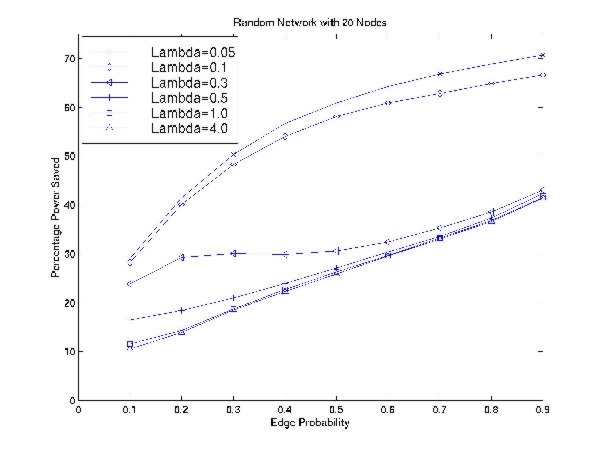
This simple observation results in huge power savings as illustrated in
the plot below. On the X-axis we plot the edge probability (small probabilities
imply sparse networks) and on the Y-axis we plot the savings.
A detailed
paper
is vailable for anonymous ftp.
