MATHEMATICAL MODELING OF A
PLATE-AND-FRAME-PRESS
Proceedings
of the American Filtration and Separations Society National Technical
Conference
April 21-24, 1996
Valley Forge, Pennsylvania
by
Scott A. Wells
Professor of Civil Engineering
Department of Civil Engineering
Portland State University
Portland, Oregon 97207-0751 USA
(503) 725-4276 FAX (503) 725-4298 scott@eas.pdx.edu
MATHEMATICAL MODELING
OF A PLATE-AND-FRAME-PRESS
by
Scott A. Wells
Professor of Civil Engineering
Department of Civil Engineering
Portland State University
Portland, Oregon 97207-0751 USA
(503) 725-4276 FAX (503) 725-4298 scott@eas.pdx.edu
Abstract
Cake filtration in a plate and frame filter press was simulated
mathematically. The process of operation of the plate-and-frame
press was based on the following steps: (i) after emptying the
cake from the prior filtration cycle, a suspension is pumped under
pressure into a cell; (ii) during this period of filling the cell,
some filtration occurs; (iii) after the filling period, cake filtration
occurs. The model described in this study considered only filtration
after the filling process. Governing equations for porosity were
developed for the plate-and-frame press and were solved numerically
using a two-dimensional spatial finite difference grid. Single-line
relaxation with over-relaxation and alternating-direction-implicit
numerical schemes were used to solve the governing equations.
Determination of appropriate initial and boundary conditions were
discussed based on characteristics of the plate-and-frame press.
INTRODUCTION
Plate-and-frame presses are used frequently in solid-liquid
separation processes. After emptying the cake from a cell of a
plate-and-frame press from a prior filtration cycle, a suspension
is pumped under pressure into the empty cell. During this period,
some filtration occurs. After filling the cell, filtration proceeds
as the pump pressure increases. The model described in this study
considered filtration occurring after the filling process. Figure
1 shows the layout of an individual plate-and-frame press cell
used in the modeling study.
THEORETICAL BACKGROUND
Governing equations
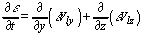
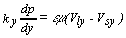
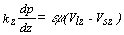
for cake filtration include solid and liquid continuity and the
reduced forms of the solid and liquid momentum equations assuming
that the inertial and gravity terms of the liquid and solid phase
and the solid-solid shear stresses are negligible and that /x=0
(where x is the spatial coordinate into the plane of Figure 1):
 1
1
 2
2
 3
3
 4
4
 5
5
where is the porosity [-], Vl is the liquid velocity [cm/s],
Vs is the solid velocity [cm/s], ' is the effective stress [kPa],
p is the porewater pressure [kPa], t is time [s], y and z are
spatial coordinates [cm], p is the total applied pressure [kPa].
By taking the derivative of Equation 3 with respect to y and the
derivative of Equation 4 with respect to x, adding the resulting
equations and substituting Equation 1,
 6
6
Using the definition of the constitutive property that  and the definition of a partial differential such that
 and
and  , and assuming
that /t >> (Vsy)/y and (Vsz)/z (Voroboyov, 1993), Equation
6 becomes
, and assuming
that /t >> (Vsy)/y and (Vsz)/z (Voroboyov, 1993), Equation
6 becomes
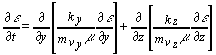 7
7
The boundary conditions for the domain shown in Figure 1 are




where i is the initial porosity of the suspension (constant over
time if the feed solution is constant and no filtration occurs
in the manifold to the individual filtration cells), o is the
terminal porosity along the filter medium (a function of time
because the applied pressure is changing as a function of time
as the pressure output of the pump supplying the filter cells
varies as a function of time), and initial is the initial porosity
distribution in the filtration cell after the filling and initial
filtration process.
MATHEMATICAL MODEL DESCRIPTION
The governing equation was solved by finite difference methods.
The spatial domain was divided into equally spaced grid points
in the y and z directions. A general implicit-explicit finite
difference equation for Equation 7 would be



 8
8
where
 ,
,
 ,
,
 ,
,

, and = 1 for fully
implicit and = 0 for fully explicit.
Direct solutions of the non-linear, implicit equation are not
used since they also require extensive computational time. Linearization
of the term at the n+1 time step was accomplished by using a
Taylor series expansion neglecting higher order terms such that
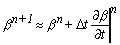
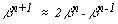
In this case, using
an approximation for /t at the n time level by using a backward
difference in time [such as, (n-n-1)/t] would eliminate the non-linearity,
such that
 . The
governing equation was solved using an alternating-direction-implicit
finite difference and a single-line over-relaxation technique.
Details are shown in Wells (1994).
. The
governing equation was solved using an alternating-direction-implicit
finite difference and a single-line over-relaxation technique.
Details are shown in Wells (1994).
DETERMINATION OF THE TERMINAL
POROSITY AS A FUNCTION OF TIME
The value of o, the
boundary condition along the z=0 and z=H axes, is a function
of time because of fluid pressure changes from the pump supplying
the filter cells. As suggested by Voroboyov (1993) a typical characteristic
curve for a pump is necessary as input to the model. The pump
characteristic curve must be supplied in the following format:
 9
9
where p is the porewater pressure supplied by the pump in
kPa, V is the suspension velocity in cm/s, pa (kPa), pb (kPa/cm/s),
and pc (kPa/cm2/s2) are empirical parameters.
The maximum applied pressure can be determined by taking the derivative
of the above equation, dp/dV = 0, and solving for Vmax at pmax.
Then
 and pmax is determined by substituting
this result in Equation 9.
and pmax is determined by substituting
this result in Equation 9.
In the model the
velocity of the suspension is estimated based on the total filtrate
production from all the filter cells. The suspension velocity
is therefore the rate of filtrate production.
DETERMINATION OF THE LIQUID VELOCITY AND FILTRATE PRODUCTION
The technique to calculate these quantities was similar to
those calculated by Wells (1991) where the momentum Equations
3 and 4 were inverted to solve for Vlz and Vly such as
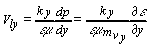
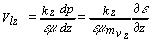
These equations were put into finite difference form and solved
from the porosity distribution. The total filtrate production,
Qtotal in cm3, was calculated from
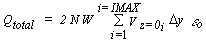
where W is the cell width in cm, N is the number of filter cells
for the entire filter press, the "2" is to account for
the filtrate production along the z=H boundary, and i is the number
of model cells along the y-axis.
CONSTITUTIVE RELATIONSHIPS
The model used various functional forms of constitutive relationships.
These relationships are between the cake porosity (or void ratio)
and effective stress and between the cake porosity and permeability
(or similarly between cake resistance and porewater pressure).
Relationships used by Wells (1991), such as
 10
10
and
 11
11
where ava [gm/cm/s2], avb [-], pka [cm2], and pkb [-] are
empirical coefficients, were used in the model.
The terminal porosity o was determined by integrating the stress-strain
relationship for the solid phase from Equation 10, such as

After integration and simplification, the porosity at any porewater
pressure p is then  12
12
The terminal porosity is determined by setting p=0 kPa in
the above equation.
POROSITY INITIAL CONDITION
The initial distribution should be based on a model of the
dynamics of filling the filtration cell. Several initial porosity
distributions were evaluated in Wells (1994). One of these initial
pressure distributions used was a parabolic distribution in z
from z=0 to z=H/2 (the centerline). This pressure distribution
was of the form
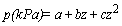
where a [kPa], b
[kPa/cm], and c [kPa/cm2] are empirical coefficients and z is
the distance from z=0 in cm. Note that dp/dz = b + 2cz. To satisfy
the boundary conditions that p=papplied (a fraction of the theoretical
maximum pressure) at z=H/2 and p=0 at z=0, the coefficient a must
be zero and (using H/2=h)
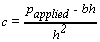
Because the filtrate production must always be non-zero and positive,
the condition that dp/dz > 0 requires that b>0 and  .
The filtrate production at z=0 is then at the beginning of the
model simulation
.
The filtrate production at z=0 is then at the beginning of the
model simulation
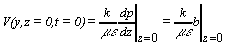 13
13
DETERMINATION
OF MODEL PARAMETERS
Data required to run
the model include the following: (1) relationship between permeability
and porosity (such as parameters pka and pkb in Equation 11),
(2) relationship between porewater pressure (or effective stress)
and porosity (such as ava and avb as in Equation 10), (3) relationship
between pump pressure and suspension velocity (pump characteristic
curve, where pa, pb, and pc are curve parameters as in Equation
9), and (4) the pressure differential at the initiation of expression
(pinitial, some fraction of p-total).
Once pinitial (at t=0) is known, the suspension velocity at t=0
can be calculated from inverting Equation 9, such that
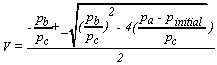
After the suspension
velocity at t=0 is known, then the parameter "b" in
Equation 13 can be determined from

where k and e are evaluated at pinitial. Once the parameter b
is known, then the initial parabolic distribution of porosity
is known.
Then after each model time step, the filtrate velocity is computed
and then the porosity at z=0 is determined based on the total
new pressure differential.
MODEL RESULTS
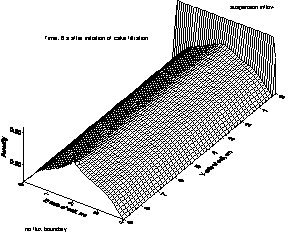
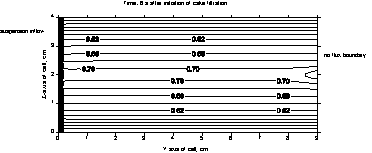
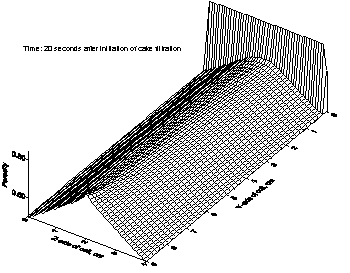
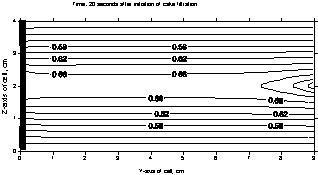
Model results of the progression of filtration in a plate
and frame press cell after 6 s and 20 s of filtration are are
shown in Figures 2-5 for a kaolin suspension in water. Characteristics
of this model run are shown in Table 1.
CONCLUSIONS
A numerical model of the dynamics of a plate-and-frame press
was developed. Important research needs to be directed toward
our improvement in understanding of slurry constitutive properties.
This type of advance will lead to the use of complex mathematical
models for evaluating and designing dewatering processes.
REFERENCES
Voroboyov, E. (1993) Personal communication, Sugar Research
Institute, Kiev, Ukraine.
Wells, S. A. (1991) " Two-Dimensional, Steady-State, Modeling
of Cake Filtration in a Laterally Unconfined Domain,"
Fluid/Particle Separation Journal, Vol. 4, No. 2, 107-116.
Wells, S. A. (1994) "Filter Press Dewatering: User's Manual
for the Two-Dimensional Model," Technical Report, Department
of Civil Engineering, Portland State University, Portland, Oregon.
Acknowledgments: Appreciation is expressed to Dr. Eugene
Voroboyov for many helpful discussions at the Sugar Research Institute,
Kiev, Ukraine while the author was a Fulbright Scholar at the
Ukrainian State University of Food Technology. Those who contributed
to the success of at the Ukrainian State University included Dr.
Ivan Malejik, the chairman of the Food Processing Cathedra, Dr.
Leonid Bobrivnik, Vice-Rector and Chief of Research, and Dr. Ivan
Guhly, the Rector of the University.