|
1
|
|
|
2
|
- Relationship of Objects
- • Friends, Nesting
- • Static Members
- Template Functions and Classes
- • Reusing Code
- • Template Specializations
- • Implicit and Explicit Instantiations
- • Partial Specializations
- • Discuss Efficiency Implications
|
|
3
|
- Remember that with data hiding and encapsulation, we force clients to
manipulate private data through public member functions. By declaring
friends, we allow non-member functions or member functions of other
classes access to private data.
- A class can declare another class to be a friend.
- When we do this, the first class gives all member functions of the
second class permission to access all of its protected and private
information (not the other way around; a class cannot declare itself a
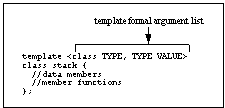
friend of another class).
|
|
4
|
- By declaring an entire class as a friend, all members of the friend
class have permission to access the protected and private members of the
declaring class. This grants special privileges to the friend class'
member functions. However, declaring a class to be a friend does not
grant any privileges to functions that may be called by member functions
of the friend class.
- class declaring_class {
- friend class class_name1,
//class_name1 is a friend
- class_name2;
//class_name2 is a friend
- ...
- };
|
|
5
|
- A class can be declared a friend before the friend class is defined.
This is because the friend declaration only needs an incomplete
declaration of the friend class. An incomplete declaration informs the
compiler that the friend class may be defined later.
- class declaring_class {
- //class_name is not previously
declared or defined, so
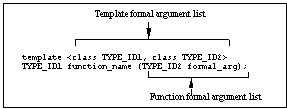
- //an incomplete declaration is
used
- friend class class_name;
//class_name is a friend class
- ...
- };
|
|
6
|
- When a class (declaring class) declares another class (friend class) to
be a friend, the friend class' member functions can invoke the protected
or private member functions or use the protected or private data members
of the declaring class.
- To do so, the friend class must have access to an object of the
declaring class' type.
- This can be done by having an object of the friend class as a data
member or a pointer to an object of the friend class.
|
|
7
|
- A non-member function can be declared a friend by placing the following
statement in the declaring class. The declaration of a friend function
takes the form of a function prototype statement, preceded by the
keyword friend.
- We saw this type of friend with operator overloading.
- Typically, friend functions are designed with formal arguments, where
clients pass either an object, the address of an object, or a reference
to an object as an argument.
- class declaring_class_name {
- friend return_type
function_name(arg_list);
- };
|
|
8
|
- We can declare a member function to be a friend by placing the following
statement in the declaring class.
- The declaration of a friend member function takes the form of a member
function prototype statement, preceded by the keyword friend.
- Member functions are declared using their class name followed by the
scope resolution operator.
- The friend member function must have an object of the class to which it
is a friend -- from a formal argument, as a local object in the member
function's implementation, as a data member in the member function's
class, or as a global object.
- class declaring_class_name {
- friend return_type
class_name::function_name(arg_list);
- };
|
|
9
|
- But... A member function cannot be declared a friend before it is first
declared as a member of its own class.
- Unlike a friend class, where we can have an incomplete declaration,
friend member function declarations (in our declaring class) cannot take
place until after the member functions have been declared (in their own
class).
- If two or more classes share the same friend class or function, those
classes share a mutual friend. This means that more than one class gives
a single friend class or function permission to access their members.
|
|
10
|
- Nesting is quite different than declaring friends. Friends provide
special privileges to members; whereas, nesting restricts the scope of a
class' name and can reduce the global namespace pollution.
- A class' definition can be placed inside the public, protected, or
private sections of another class. The purpose of this is to hide the
nested class' name inside another class, restricting access to that
name.
- It does not give either the outer class or the nested class any special
privileges to access protected or private members of either class.
- A nested class does not allow the outer class access to its hidden
members....the name of the nested class is hidden.
|
|
11
|
- If a class is defined within another class in the public section, the
nested class is available for use the same as objects defined for the
outer class.
- To define objects of a public nested class, the name of the nested class
must be qualified by the outer class' name (i.e.,
outer_class::nested_class).
- class outer_class {
- public:
- class nested_class {
- public:
- nested_class(); //nested
class' constructor
- ...
- };
- outer_class::nested_class object; //define an object
|
|
12
|
- If a class is defined within another class in the private section, the
nested class is available for use only by the member functions of the
outer class and by friends of that class. Clients cannot create objects
of the nested class type.
- In the implementation of a nested class' member functions, where the
interface is separate from the implementation, an additional class name
and scope resolution operator is required.
- //nested class' constructor implementation
- outer_class::nested_class::nested_class() {
- ...
- }
|
|
13
|
- #include "employee.h"
- class tree { //binary tree
class
- public:
- class node; //forward
reference to node
- tree(); //default
constructor
- tree(const tree &); //copy constructor
- ~tree(); //destructor
- tree & operator = (const
tree &); //assignment op
- void insert(const employee
&); //insert employee
- void write() const; //write employee info
- private:
- node* root; //root node of tree
- friend static void copy(node*
&, const node*);
- friend static void
destroy(node*);
- friend static tree::node*
add(node*, node*);
- };
- Notice that the friend declarations must occur after node is declared to
be a private class of tree. Also notice that the definition must still
qualify node as tree::node.
|
|
14
|
- #include "tree.h"
- class tree::node { //node for binary tree
- public:
- node() : //default
constructor
- left(0),
- right(0) {
- }
- node(const employee &obj)
: //one arg constructor
- emp(obj),
- left(0),
- right(0) {
- }
- employee emp; //employee object
- node* left; //left child node
- node* right; //right child node
- };
|
|
15
|
- static void copy(tree::node* &new_node,
- const tree::node*
old_node) {
- if(old_node) {
- new_node = new
tree::node(old_node->emp);
- copy(new_node->left,
old_node->left);
- copy(new_node->right,
old_node->right);
- }
- }
- tree::tree(const tree &tree) :
//copy constructor
- root(0) {
- copy(root, tree.root);
- }
- This solution has allowed the client to create other node classes to
represent other types of data without running into naming conflicts.
|
|
16
|
- static void destroy(tree::node* node_ptr) {
- if(node_ptr) {
- destroy(node_ptr->left);
- destroy(node_ptr->right);
- delete node_ptr;
- }
- }
- tree::~tree() {
//destructor
- destroy(root);
- }
- Since these utility functions are recursive in nature, each invocation
relies on its arguments to determine both the results of the operation
and the depth of recursion. Therefore, they are prime candidates for
being considered as non-member static functions.
|
|
17
|
- static tree::node* add(tree::node* node_ptr,
- tree::node*
new_node) {
- if (node_ptr) {
-
if(new_node->emp.get_salary() <
-
node_ptr->emp.get_salary() )
- node_ptr->left =
add(node_ptr->left, new_node);
- else
- node_ptr->right =
add(node_ptr->right, new_node);
- return (node_ptr);
- } else
- return (new_node);
- }
- void tree::insert(const employee &emp) { //insert employee
- node* new_node = new node(emp);
- root = add(root, new_node);
- }
|
|
18
|
- By simply making the static utility functions members, they have direct
access to the node class' public members, even if the node class is
defined in the tree class' private section. This can be done without
declaring our functions as friends.
- Static member functions do not have a this pointer, just like non-member
functions.
- class tree {
- •••
- private:
- node* root; //root node of tree
- static void copy(node* &,
const node*);
- static void destroy(node*);
- static tree::node* add(node*,
node*);
- static void traverse(const
node*);
|
|
19
|
- tree::tree(const tree &tree) :
//copy constructor
- root(0) {
- copy(root, tree.root);
- }
- //This is the implementation of a static member function
- void tree::copy(node* &new_node, const node* old_node) {
- if(old_node) {
- new_node = new
node(old_node->emp);
- copy(new_node->left,
old_node->left);
- copy(new_node->right,
old_node->right);
- }
- }
|
|
20
|
- Shared properties are represented by static class members. Static class
members can be either static data members or static member functions.
These members can be declared in either the public, protected, or
private sections of a class interface.
- When a member function is declared as static, we are not limited to
using this function through an object of that class. This function can
be used anywhere it is legal to use the class itself. This is because
static member functions are invoked independent of the objects and do
not contain a this pointer.
- It can be called via: class::function(args)
|
|
21
|
- To specify static member functions, we must declare the functions to be
static in the class definition (interface file) using the keyword static
.
- Then, define those static member functions in the class implementation
file.
- The definition of our static member functions should look identical to
the definition of non-static member functions.
- The scope of a static member function is the same as that of a
non-static member function.
- Access to a static member function from outside the class is the same as
access to a non-static member function and depends on whether the member
is declared as public, protected, or private.
|
|
22
|
- When we use the keyword static in the declaration a data member, only
one occurrence of that data member exists for all instances of the
class. Such data members belong to the class and not to an individual
object and are called static data members. Static data represents class
data rather than object data.
- To specify a static data member, we must supply the declaration inside
the class interface and the definition outside the class interface.
Unlike a non-static data member, a static data member's declaration does
not cause memory to be allocated when an object is defined.
|
|
23
|
- //static data member declaration (class interface)
- class class_name {
- ...
- static data_type
static_data_member;
- ...
- };
- A static data member's definition must be supplied only once and is
usually placed in the class implementation file. A static data member's
definition must be preceded by the class name and the scope resolution
operator before the static data member's identifier.
- //static data member definition (class implementation)
- data_type class_name::static_data_member = initial_value;
|
|
24
|
- It is important to realize that memory is allocated for static data
members when we explicitly define those static data members, not when we
declare the static data members as part of a class definition. Think of
the static data member declarations within a class as external
references to data members defined elsewhere.
- Clients can access a public static data member by saying class_name::static_data_member
- It is also possible for clients to access a public static data member
once an object is defined for that class by saying
object_name.static_data_member.
|
|
25
|
|
|
26
|
- Class templates allow us to apply the concept of parametric polymorphism
on a class-by-class basis.
- Their purpose is to isolate type dependencies for a particular class of
objects.
- Using class templates, we shift the burden of creating duplicate classes
to handle various combinations of data types to the compiler.
- Type dependencies can be found by looking for those types that cause a
particular class to differ from another class responsible for the same
kind of behavior.
|
|
27
|
- With class templates, we simply write one class and shift the burden of
creating multiple instances of that class to the compiler.
- The compiler automatically generates as many instances of that class as
is required to meet the client's demands without unnecessary
duplication.
- Specialized (and partially specialized) template classes can be used to
handle special cases that arise.
- The syntax for implementing class templates is similar to that of
defining and declaring classes themselves. We simply preface the class
definition or declaration with the keyword template followed by a
parameterized list of type dependencies.
|
|
28
|
- We begin with the keyword template followed by the class template's
formal argument list within angle
brackets (< >). This is followed by the class interface.
- The template formal argument list consists of a comma separated list
containing the identifiers for each formal argument in the list. There
must be at least one formal argument specified.
- The scope of the formal arguments is that of the class template itself.
|
|
29
|
- The template formal argument list can contain three different kinds of
arguments:
- identifiers that represent type dependencies,
- identifiers that represent values, and i
- dentifiers that represent type dependencies based on a template class.
- A type dependency allows the identifier listed to be substituted for the
data type specified by the client at instantiation time. More than one
identifier can be listed, each prefaced by the keyword class or typename
to indicate that this is a type dependency.
|
|
30
|
- We can specify a non-type identifier in the template formal argument
list, prefaced by its data type.
- A non-type specifier allows the identifier listed to be substituted for
a value specified by the client at instantiation time.
- template <data_type nontype_identifier>
- The data type of non-type identifiers must be an integral type, an
enumeration type, a pointer to an object, a reference to an object, a
pointer to a function, a reference to a function, or a pointer to a
member.
- They cannot be void or a floating point type.
|
|
31
|
- Clients must specify the values for non-type identifiers explicitly
inside of angle brackets when
defining objects class templates.
- //function template
declaration
- template <char non_type,
class TYPE_ID>
- class t_class {
- public:
- TYPE_ID function(int
TYPE_ID);
- };
- //client code
- t_class <'\n',int> obj;
- Using non-type formal arguments allows the client to specify at compile
time some constant expression when defining an object, which can be used
by the class to initialize constants, determine the size of statically
allocated arrays, or any other initialization.
|
|
32
|
- A class template's formal argument list may include other template
classes. This means that the type dependency is based on an
instantiation of another abstraction. When this is the case, the
identifier representing the type dependency is preceded by the keyword
template, the specific type dependencies to be substituted supplied in
angle brackets, and the keyword class:
- template <template
<actual_args> class_id>
- When making use of this features, the template classes being used as
formal arguments must be defined before the first use that causes an
instantiation of the class template.
|
|
33
|
- Class templates declared to have default template formal arguments can
be used by the client with fewer actual arguments.
- Default arguments may be specified for type dependencies, non-type
values, and template class arguments.
- template <class TYPE=int>
class list;
- To create an instantiation of a class using all default values for
initialization, empty angle brackets must be used by the client:
- list <> object;
|
|
34
|
- Member functions that are part of a class template are themselves
template functions. Therefore, we must preface member functions defined
outside of the class with the template's header.
- Member functions can either be defined inside of a class template as
inline members or separated from the class' definition.
- template <class TYPE1, int
sz,template<TYPE1> class
-
TYPE2>
- list & list<TYPE1,sz,TYPE2>::operator = (const list &) {
- //function's definition
- }
|
|
35
|
- Template classes can support static data members. A static data member
declared within a class template is considered to be itself a static
data member template.
- With template classes, the compiler automatically allocates memory for
the static members for each instantiation of the class.
- Each object of a particular template class instantiation shares the same
static data members' memory. But, objects of different template class
instantiations do not share the same static data members' memory.
|
|
36
|
- Such static data members are declared within the class definition and
are defined outside the class, possibly in the class implementation
file.
- template <class TYPE>
- class stack {
- static int data;
- }
- template <class TYPE>
- int stack<TYPE>::data = 100;
|
|
37
|
- When defining an object, clients must specify the data types and values
used for substitution with the type and non-type dependencies.
- For example, if a class template has one type dependency and one
non-type:
- class_name <data_types, values> object;
- Only instances used by the client cause code to be generated for any
particular compilation.
- If the identifiers representing the types expected match exactly and if
the non-type template arguments have the identical values as a previous
instantiation, the template class is not re-instantiated.
|
|
38
|
- A class template will be implicitly instantiated when it is referenced
in a context that requires a completely defined type.
- class_name <int> object causes an implicit instantiation.
- Because objects are not formed when we say class_name <int> * ptr;
therefore, the class does not need to be defined and an integer
instantiation of this class is not generated.
- However, when the pointer is used in a way that requires the pointer
type to be defined (such as saying *ptr), then an instantiation will be
generated at that time.
|
|
39
|
- If we define data members that are themselves template classes, the
classes are not implicitly instantiated until those members are first
used.
- In the following class, the list_object data member's class is not
implicitly instantiated until the point at which data member is first
used.
- On the down side, unless explicit instantiation (explained in the next
section) is requested, errors can only be found by explicitly using all
member functions for each use expected. This applies to syntax errors as
well as run time errors.
|
|
40
|
- template <class TYPE, int sz>
- class stack {
- public:
- stack();
- int push(const TYPE &
data);
- TYPE & pop();
- private:
- //this does not instantiated
the list class
- list <int, 100, stack>
list_object;
- };
- template <class TYPE, int sz>
- int stack<TYPE,sz>::push(const TYPE & data) {
- //if this is the first usage of
the list_object member,
- //then the list class is
instantiated
- list_object <<data;
- ...
|
|
41
|
- Clients can cause explicit instantiations to take place by placing the
keyword template in front of a class name when defining objects.
- Explicit instantiations can be used to improve the performance of our
compiles and links.
- It can be used to support better code generation and faster and more
predictable compile and link times.
- The drawback is that a template class can only be explicitly
instantiated once, for a particular set of template actual arguments.
|
|
42
|
- By explicitly instantiating a class we also cause all of its member
functions and static data members to also be explicitly instantiated
unless they have previously been explicitly instantiated themselves.
- We can also explicitly instantiate just select member functions of a
class template if all member functions are not needed.
- Explicit instantiations of a class are placed in the same namespace
where the class template is defined, which is the same if the class were
implicitly instantiated.
- But, default template arguments cannot be used in an explicit
instantiation.
|
|
43
|
- And, the class template must be declared prior to explicitly
instantiating such a class.
- //class template declaration
- template <class TYPE, int sz> class stack;
- template class stack<int,100>;
//explicit instantiation
- When we use a class identifier as the second operand of the direct or
indirect member access operators (the . and -> operators) or after
the scope resolution operator, we must precede the class' identifier
with the keyword template.
- list_object->template node<int> * ptr = new node<int>;
- //the following is illegal if node is a class template
- list_object->node<int> * ptr = new node<int>;
|
|
44
|
- Supporting special cases is particularly important when dealing with
class templates.
- For some types, we may find that certain member functions need partial
specialization.
- For other types, we may find that additional data members are required.
- To support special cases, we can implement specific instantiations of
our member functions and classes to customize the functionality for a
given set of data types and values.
|
|
45
|
- To specialize a member function, we must define the specialized version
of the function. A partial specialization specifies what it expects as
the template's actual arguments following the class identifier. These
arguments must be specified in the order that corresponds to the formal
template argument list.
- Not all arguments must be specialized; in these situations, the
identifiers specified in the formal template argument list may be used
instead of specific types and/or values. When all arguments are
specialized, we have an explicit specialization; in this case, the
template's formal argument list is empty (e.g., template <>).
|
|
46
|
- template <class TYPE>
class stack {
- private:
- TYPE * stack_array;
- const int stack_size;
- int stack_index;
- public:
- stack (int size=100):
stack_size(size), stack_index(0) {
stack_array = new TYPE[size]; } ...
- };
- template <class TYPE> void stack<TYPE>::push(TYPE item) {
- if (stack_index < stack_size)
{
- stack_array[stack_index] =
item;
- ++stack_index; } }
- //An explicit specialization
- template <> void stack <char *>::push(char * item) {
- if (stack_index < stack_size)
{
- stack_array[stack_index] = new
char[strlen(item)+1];
-
strcpy(stack_array[stack_index], item);
- ++stack_index; } }
|
|
47
|
- Partial specialization of a class template is the mechanism that we can
use to cause one implementation of a class to have different behavior
than another.
- This is primarily useful when a class requires different behavior
depending on the data types used by the client.
- We must define the specialized version of the class after the class
template is defined or declared
(called the primary template).
- All members must be completely defined for that version. This means that
all member functions must be defined for a specialized class template,
even in the case where the functionality is unchanged.
|
|
48
|
- //primary class template
- template <class TYPE1, int sz, template<TYPE1> class TYPE2>
- class list {...}
- //partial specialization
- template <class TYPE1, int sz, template<TYPE1> class TYPE2>
- class list <TYPE1
*,sz,TYPE2> {...}
- //partial specialization
- template <int sz, template<TYPE1> class TYPE2>
- class list<list,
sz,TYPE2<list>>{...}
- //partial specialization
- template <template<TYPE1> class TYPE2>
- class
list<list,100,TYPE2<list>>{...}
- //explicit specialization
- template <> class
list<list,100,list<list>>{...}
|
|
49
|
- template <class TYPE> class
stack {
- private:
- TYPE * stack_array;
- const int stack_size;
- int stack_index;
- public:
- stack (int size=100):
stack_size(size), stack_index(0) {
stack_array = new TYPE[size]; }
- void push(TYPE item);
- TYPE pop(void);
- };
- template <class TYPE> class stack <char *> {
- private:
- char ** stack_array;
- int stack_index;
- public:
- stack(int size=100):
stack_index(0){
- stack_array = new char
*[size]; } ...
|
|
50
|
- Member functions can be defined as inline in the same file as the
class's interface using the inline keyword or defined in a separate
file.
- When we define the member functions of our class templates in a separate
implementation file, we define the class' interface in a header file in
the same way that we would do for a non-template class.
- To do so requires that we define or declare our member function
templates with the export keyword.
- This tells the compiler that the functions can be used in other
"translation units" and may be compiled separately
|
|
51
|
- There are some restrictions.
- Templates defined in an unnamed namespace cannot be exported.
- But, an exported template only needs to be declared in the file in which
it is instantiated.
- Declaring member functions of a class template as exported means that
its members can be exported and used in other files.
- If the keyword export was not used, the definition of the function must
be within the scope of where we define the objects. This would require
that we include the implementation file in our header file and
ultimately in client code as well (e.g., t_class.h could include
t_class.cpp)
|
|
52
|
- #include "t_class.h"
- main() {
- t_class<int, float> obj;
//defining an object
- }
- //t_class.h
- //declarations of the function template(s)
- template<class TYPE_ID1, class TYPE_ID2>
- class t_class {
- public:
- t_class();
- t_class(const t_class &);
- ~t_class();
- void t_member(TYPE_ID1,
TYPE_ID2);
- private:
- TYPE_ID1 data_1;
- TYPE_ID2* ptr_2;
- };
|
|
53
|
- //t_class.cpp
- //implementation of the member function
- export template<class TYPE_ID1, class TYPE_ID2>
- void t_member(TYPE_ID1 arg_1, TYPE_ID2 arg_2) {...}
- export template<class TYPE_ID1, class TYPE_ID2>
- t_class() {...}
- export template<class TYPE_ID1, class TYPE_ID2>
- t_class(const t_class & source) {...}
- export template<class TYPE_ID1, class TYPE_ID2>
- ~t_class() {...}
|
|
54
|
- One of the most serious drawbacks of class templates is the danger of
generating an instance of the class that is incorrect because of type
conflicts.
- Except by writing specialized template classes to take care of such
cases, there is no way to protect the client from using the class
incorrectly, causing erroneous instances of the class to be generated.
- Be very careful when writing class templates to ensure that all possible
combinations will create correct classes.
|
|
55
|
- Realize that when we write a class template we may not know the types
that will be used by the client.
- Therefore, we recommend using type dependencies only once within the
class's formal argument list.
- Also, make sure to handle the use of both built-in and pointer types.
- And, when we implement our own user defined types, realize the
importance of overloading operators in a consistent fashion -- so that
if template classes are used with those new data types, the operators
used by the member functions will behave as expected and will not cause syntax
errors when used...
|
|
56
|
|
|
57
|
- We begin with the keyword template followed by the template's formal
argument list inside of angle brackets (< >).
- This is followed by the function's header (i.e., the function's return
type, name, and argument list).
- The signature of a function template is the function's signature, its
return type, along with the template's formal argument list.
|
|
58
|
- //Prototype:
- template <class TYPE1, class TYPE2>
- void array_copy(TYPE1 dest[], TYPE2 source[], int size);
- //A later definition:
- template <class TYPE1, class TYPE2>
- void array_copy(TYPE1 dest[], TYPE2 source[], int size) {
- for(int i=0; i < size; ++i)
- dest[i] = source[i];
- }
- //The client can call this function using:
- int int_array1[100], int_array2[100], int_array3[20];
- float real_array[100];
- char char_array[20];
- array_copy(int_array1, int_array2, 100);
- array_copy(int_array3, int_array1, 20);
- array_copy(real_array, int_array1, 100);
- array_copy(int_array1, char_array, 20);
|
|
59
|
- Type dependencies are deduced by the compiler by matching the actual
arguments in a call with the formal argument in the function template
formal argument list.
- Type dependencies may also be explicitly specified in the function call,
adding flexibility in how we specify our formal arguments.
- By explicitly specifying type dependencies, the return type can be a
type distinct from the types in the function's formal argument list.
- function_identifier <data type list> (actual arguments)
|
|
60
|
- We can explicitly specify both types, or just the first type. However,
it is not possible to explicitly specify the type for the second type
without specifying the type for the first type as well.
- array_copy<int [], int []>(int_array1, int_array2, 100);
- array_copy<float []>(real_array, int_array1, 100);
- We can have the return type also be based on a type dependency by
specifying an additional type in our template's formal argument list.
Because a return type cannot be deduced, clients must specify that type
explicitly when calling the function.
|
|
61
|
- template <class TYPE1, class TYPE2, class TYPE3>
- TYPE1 array_copy(TYPE2 dest[], TYPE3 source[], int size) {
- for(int i=0; i < size; ++i)
- dest[i] = source[i];
- }
- //client program
- char a[100];
- char b[20];
- cin.getline(b, 20, '\n');
- //explicitly specify type dependency for only first type
- int result;
- result = array_copy<int> (a,b,strlen(b));
|
|
62
|
- A specialized template function is a function that we implement with the
same signature as a template function instantiation.
- The specialization must be defined after the definition of the function
template, but before the first use of the specialization.
- The definition of the specialized template function must be preceded by
the template keyword and followed by an empty set of angle brackets
(<>) (i.e., template<>).
- The specialization will then be used instead of a version that the
compiler could instantiate.
|
|
63
|
- The most specialized functions are those who's arguments can be applied
to a generalized function template or some other specialization.
- When calling a function, the most specialized function is used, if one
is available that matches the actual argument list.
- This means that specialization takes precedence followed by generalized
function templates.
- If a regular C++ function with the same name and signature as a
specialized template function is declared before the definition of the
function template, that declaration is hidden by the template or any
specialized template function that follows.
|
|
64
|
- template <class TYPE1, class TYPE2> //function template
- void array_copy(TYPE1 dest[], TYPE2 source[], int size) {
- for(int i=0; i < size; ++i)
- dest[i] = source[i];
- }
- template<> void array_copy(char* dest[], char* source[], int size)
{
- for(int i=0; i < size; ++i) {
- dest[i] = new
char[strlen(source[i]) + 1];
- strcpy(dest[i], source[i]);
- }
- }
- //This specialized function is called when:
- char saying1[] = "Hello World";
- char saying2[] = "This is a great day!";
- char* s1[2] = {saying1, saying2};
- char* s2[2];
- array_copy(s2, s1, 2);
|
|
65
|
- It is possible to define our function templates in a separate
implementation file and simply declare that those functions exist in the
software that uses them. To do so requires that we define or declare our
function templates with the export keyword.
- When export is not used, the template function must be defined in every
file that implicitly or explicitly instantiates that template function.
- Functions exported and declared to be inline are just taken to be inline
and are not exported.
- //t_func.h declarations of the function
template(s)
- template<class TYPE_ID1,
class TYPE_ID2>
- void t_funct(TYPE_ID1,
TYPE_ID2);
- //t_func.cpp implementation of
the function template(s)
- export template<class
TYPE_ID1, class TYPE_ID2>
- void t_funct(TYPE_ID1 arg_1,
TYPE_ID2 arg_2) {...}
|
|
66
|
- So when should we use export and when should we simply include our
function template implementations in our client code?
- When we have large functions or when their are many type dependencies or
specializations, it is often easier to debug our code by using separate
compilation units and use the exporting process.
- On the other hand, if we have small function templates, few type
dependencies, and limited (to no) specialized templates, then there may
be no advantage to compiling them separately.
|
|
67
|
- template <class TYPE> //qsort.h
- inline void swap(TYPE v[], int i, int j) {
- TYPE temp;
- temp = v[i];
- v[i] = v[j];
- v[j] = temp;
- }
- template <class TYPE>
- void qsort(TYPE v[], int left, int right) {
- if (left < right) {
- swap(v, left, (left+right)/2);
- int last = left;
- for (int i=left+1; i <=
right; ++i)
- if (v[i] < v[left])
- swap(v, ++last, i);
- swap(v, left, last);
- qsort(v, left, last-1);
- qsort(v, last+1, right);
- } }
|
|
68
|
- //main.cpp
- #include <iostream>
- using namespace std;
- #include "qsort.h"
- int ia[]={46, 28,
35, 44, 15,
22, 19 };
- double da[]={46.5, 28.9, 35.1, 44.6, 15.3, 22.8, 19.4};
- int main() {
- const int
isize=sizeof(ia)/sizeof(int);
- const int
dsize=sizeof(da)/sizeof(double);
- qsort(ia, 0, isize-1); // integer qsort
- for(int i=0; i < isize; ++i)
- cout << ia[i] <<
endl;
- qsort(da, 0, dsize-1); // double qsort
- for(i=0; i < dsize; ++i)
- cout << da[i] <<
endl;
- return (0);
- }
|
|
69
|
- One of the most serious drawbacks of function templates is the danger of
generating an instance of the function that is incorrect because of type
conflicts.
- Except by writing specialized template functions to take care of such
cases, there is no way to protect the client from using the function
incorrectly, causing erroneous instances of the function to be
generated.
- Be very careful when writing function templates to ensure that all
possible combinations will create correct functions.
|
|
70
|
- Realize that when we write a function template we may not know the types
that will be used by the client.
- Therefore, we recommend using type dependencies only once within the
function's formal argument list.
- Also, make sure to handle the use of both built-in and pointer types.
- This may mean that we provide overloaded generalized function templates
or template function specializations.
|

 Notes
Notes