|
1
|
|
|
2
|
- Exception Handling
- • Throwing an Exception
- • Detecting an Exception
- • Catching an Exception
- • Examine an Example using Classes and Operator Overloading
|
|
3
|
- C++ allows us to detect error conditions at any point in a program (the
throw point) and then transfer control and information (the exception)
to another point in the program (the exception handler) for error
processing.
- This process (exception handling) allows functions to detect error
conditions and then defer the processing or handling of those error
conditions to a direct or indirect caller of those functions.
- Exception handling allows us to separate normal processing from error
processing.
- This, in turn, improves the structure, organization, and reusability of
our software.
|
|
4
|
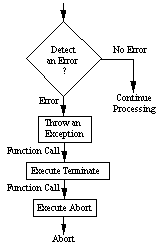
- When an error condition is detected, an exception can be created and
control transferred to an exception handler by executing a throw
expression.
- A throw expression consists of the operator throw optionally followed by
an operand of some type.
- if (i != 42) //detect error
condition
- throw i; //throw an exception
- This causes the program to abort whenever an exception occurs. The abort
occurs because the default in C++ is to abort whenever an exception is
thrown that is not explicitly processed by the program. This is probably
only useful for the simplest programs.
|
|
5
|
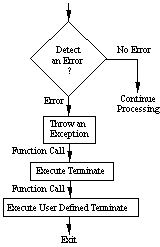
- An exception that is thrown and is not directly detected and handled by
the program results in a call to a run time library function called
terminate. The default behavior for terminate is to call abort.
|
|
6
|
- Fortunately, our program can gain control by replacing the call to abort
with a call to a function that we provide.
- We pass the address of our function to the library function
set_terminate. The address of the previous function is returned and the
address we pass is saved in its place.
- Whenever terminate is called, our function will also be called.
- void user_terminate() {...)
//user supplied terminate
- int main() {
- set_terminate(user_terminate);
//install user function
- ...
|
|
7
|
- There are four rules that apply to the function that we supply:
- 1) it must not take any arguments,
- 2) it must not return data,
- 3) it must not return; it can only terminate by calling exit or abort,
and
- 4) it is not allowed to throw an exception.
- 5) the header file <exception> is needed to use set_terminate.
|
|
8
|
- void user_terminate() {
//user supplied terminate
- cout <<"user
terminate function calling exit" <<endl;
- exit(1); //abnormal
program exit
- }
- int main() {
- int i;
- set_terminate(user_terminate);
//install user function
- cout <<"Enter an
integer: ";
- cin >>i;
- if (i != 42) //detect error
condition
- throw i; //throw an
exception
- cout <<"no throw was
executed" <<endl;
- cout <<"normal
program exit; i = " <<i <<endl;
- return(0);
- }
|
|
9
|
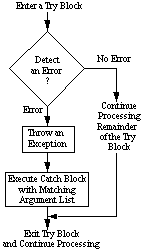
- To detect specific exceptions, we must specify when we want exception
detection to be active.
- Think of this as "turning on" exception handling for a
particular section of code (the try block).
- A try block is a compound statement preceded by the try keyword.
- Once the thread of control enters a try block, exception handling is in
effect until the try block is exited.
- Think of a try block as specifying when we want to detect exceptions. We
can only detect an exception that is thrown when the thread of control
is inside of a try block.
|
|
10
|
- Therefore, try blocks establish when exception handling is in effect.
- If an exception is thrown outside of a try block, terminate is called.
- When we are in a try block, we are able to select and handle different
types of exceptions. This is called catching an exception.
- The following demonstrates a try block that "turns on"
exception handling for our entire program:
- int main() {
- try {
- ... //program code
- }
- ... //code to handle exceptions
- cout <<"normal
program exit" <<endl;
- return(0); }
|
|
11
|
- When an exception is thrown, we can associate an operand of some type
with the throw operator.
- The type of the operand determines the type of the exception.
- Control is passed to a block of code (the catch block) corresponding to
that type.
- The value of the operand (the exception) associated with throw is passed
to the catch block (the exception handler) as a temporary.
- throw i; //under some condition
throw an exception
- //with an integer
argument
- catch(int x) { //catch integer exceptions
- ...
- }
|
|
12
|
- A catch block has access to the value of the exception, but cannot
modify the original value.
- This is true even if the operand is a reference. Any change to the
operand does not affect the original value, only the temporary copy.
- The type of a throw expression is void and has no residual value.
- If we use throw within a try block without an operand, a catch block is
not executed. Instead, terminate is called.
|
|
13
|
- A catch block immediately follows the try block and begins with the
catch keyword followed by the type and formal argument (in parentheses)
that this catch block is designed to accept.
- There must be at least one catch block immediately following every try
block.
|
|
14
|
- int main() {
- int i;
- cout <<"Enter an
integer: ";
- cin >>i;
- try {
- if (i != 42) //detect error
condition
- throw i; //throw an exception
- cout <<"no throw
was executed" <<endl;
- }
- catch(int x) { //catch integer
exceptions
- cout <<"exception
handler called; arg = " <<x <<endl;
- i = 42; //set it to correct value
- }
- cout <<"normal
program exit; i = " <<i <<endl;
- return(0);
- }
|
|
15
|
- First, a catch block is only executed as a result of throwing an
exception within a try block.
- Second, if a throw is executed, control is immediately passed to the
appropriate catch block.
- The statements following the throw are not executed.
- Third, when the catch block is done executing, control goes to the
statement immediately following the try block and associated sequence of
catch blocks in which the exception was handled; it does not continue
with the statement following the throw.
- Of course, if a catch block contains a return, exit, or abort, then the
program either returns from the function containing the catch block or
exits the program.
|
|
16
|
- int main() {
- int i;
- cout <<"Enter an
integer: ";
- cin >>i;
- try {
- if (i != 42) //detect error
condition
- throw i; //throw an exception
- cout <<"no throw
was executed" <<endl;
- }
- catch(int x) { //catch integer
exceptions
- cout <<"exception
handler called; arg = " <<x <<endl;
- i = 42; //set it to correct value
- }
- cout <<"normal
program exit; i = " <<i <<endl;
- return(0);
- }
|
|
17
|
- Once a throw is executed, control is immediately transferred from the
try block to the first catch block in the thread of control whose type
matches the type of operand associated with the throw.
- The catch block is then executed and we either terminate, return, or
continue at the first statement following the sequence of catch blocks
in which the exception was handled.
- Think of throw as analogous to a function call and catch as analogous to
a function definition. There can be multiple catch blocks each with a
unique "formal argument" type.
|
|
18
|
- When we throw an exception, it is as if we are using the throw operator
and its associated operand to "call" a catch block
"passing" an argument. The type of the operand must be an
exact match with the type specified in the associated catch block,
except for the following three cases:
- 1) the operand (or, actual argument) matches a constant of the same
type, a reference of that type, or a constant reference of that type,
- 2) the operand is an array containing elements of some type that
matches a pointer to that type, or
- 3) the operand is a pointer that matches a pointer to void.
|
|
19
|
- The operand of the throw operator determines which catch block is
selected by matching its type with the type of the catch blocks.
- If we use the type void* for a catch block, it should come after any
other catch block specifying a pointer type.
- This is because the catch blocks are checked in sequence and the first
catch block matching the type is used.
- Since void* matches all possible pointer types, we would never be able
to access a catch block with a specific pointer type if a void* catch
block preceded it.
|
|
20
|
- In the previous example, we did not use the value of the throw operand
in the catch blocks so we did not need to specify an identifier in the
catch block's argument list, just the type.
- If we want to catch any exception independent of the type, we can use
the ellipses (...) as the type of a catch block.
- If a catch block using ellipses is specified, it must be the last catch
block in the sequence and is guaranteed to catch exceptions of any type.
- Of course, if a catch block for a particular type precedes a catch block
using the ellipses, then it will catch an exception of that particular
type before the catch block with the ellipses.
|
|
21
|
- try {
- if (c != 'x')
- throw c; //throw exception of type char
- if (i != 42)
- throw i; //throw exception of type int
- cout <<"no throw
was executed" <<endl;
- }
- catch(char) { //catch char
exception
- cout <<"char
exception handler called" <<endl;
- }
- catch(...) { //catch all other exceptions
- cout <<"universal
exception handler called" <<endl;
- }
|
|
22
|
- Try blocks can be nested, either statically at compile time or
dynamically based on the flow of control.
- When we throw an exception, the catch blocks associated with the try
block containing the throw are searched for a type matching the
exception.
- If no match is found, the catch blocks associated with the statically or
dynamically surrounding try block (i.e., a try block entered, but not
exited) are searched.
- This process continues until either a matching catch block is found or
there are no more try blocks, in which case the function terminate is
called.
|
|
23
|
- try { //outer try block
- cout <<"Enter a
character and an integer: ";
- cin >>c >>i;
- try { //inner try block
- if (c != 'x')
- throw c; //throw exception of type char
- if (i != 42)
- throw i; //throw exception of type int
- cout <<"no throw
was executed" <<endl;
- }
- catch(char) { //inner catch
block
- cout <<"char
exception handler called" <<endl;
- }
- cout <<"either char
exception or no throw" <<endl;
- }
- catch(...) { //outer catch block
- cout <<"universal
exception handler called" <<endl;}
|
|
24
|
- When an exception occurs and either:
(1) no try block statically surrounds the throw point or (2) no
catch blocks are found that match the type of exception thrown when a
try block is present, then a process called stack unwinding begins.
- If we are in a function, any automatic variables and formal arguments on
the stack are destroyed in the same way as when control returns from a
function.
- But, instead of returning control to the calling function, that function
is searched for a dynamically surrounding try block.
- If found, its associated catch block(s) are checked for a type matching
the exception.
|
|
25
|
- If found, control is passed to the catch block matching the type of the
exception.
- If no try block is found or if no catch block with a type matching the
exception is found, this process of returning from a function and
unwinding the stack continues until a catch block of the appropriate
type is found.
- If none is found, the function terminate is called.
- The catch block itself can throw an exception in two ways:
- 1) by throwing an exception with an associated operand of some type, or
- 2) by throwing an exception with no operand (called re-throwing the
exception).
|
|
26
|
- In order to completely declare a function, we must specify the types of
exceptions that may be thrown by that function in addition to the formal
argument types and return type.
- By default, a function can throw any exception.
- We can specify exactly what types of exceptions a function may throw by
listing them in the function prototype or in the function header when a
function is defined.
- This is called an exception specification.
|
|
27
|
- An exception specification consists of the throw keyword followed by a
list of exception types enclosed in parentheses.
- The exception specification is the last item in a function declaration
or function header.
- The list may be empty.
- This guarantees that the function will not throw any exceptions.
- A non empty list guarantees that the function will only throw exceptions
of the type(s) specified in the list.
- If the exception specification is absent, the function can throw any
type of exception.
|
|
28
|
- void a_function() throw(char, int); //exception spec
- int main() {
- try { //detect exceptions (in main)
- a_function();
- cout <<"returned
from a_function" <<endl;
- }
- catch(char) { //catch char
exceptions
- cout <<"char
exception handler called" <<endl;
- }
- catch(int) { //catch int exceptions
- cout <<"int
exception handler called" <<endl;
- }
- cout <<"normal
program exit" <<endl;
- return(0);
- }
|
|
29
|
- void a_function() throw(char, int) { //exception spec
- int i;
- char c;
- cout <<"Enter a
character and an integer: ";
- cin >>c >>i;
- if (c != 'x')
- throw c; //throw char exception
- if (i != 42)
- throw i; //throw int exception
- cout <<"no throw was
executed" <<endl;
- }
- If a function throws an exception that is not in the exception
specification list, a call to a run time library function called
unexpected is made. The default behavior for unexpected is to call
terminate.
|
|
30
|
- Fortunately, our program can gain control by replacing the call to
terminate with a call to a function that we provide. We pass the address
of our function to the library function set_unexpected. The following
shows the syntax:
- void user_unexpected() {
//user supplied function
- ...
- }
- int main() {
- set_unexpected(user_unexpected);
//install user function
|
|
31
|
- When new cannot allocate the requested memory, it calls a default
callback function from the standard library called new_handler.
- This function throws an exception of type bad_alloc.
- By registering a callback function, our own can be called instead of new_handler.
- This can be done by calling the function set_new_handler.
- This function takes one argument: a pointer to a function that takes no
arguments and returns void.
- It returns a pointer to the previous callback, which is initially the
default (new_handler).
|
|
32
|
- void out_of_mem();
//user new handler callback
- int main() {
- set_new_handler(out_of_mem);
//install user new handler
- while(true)
- int *p = new int[1024]; //gobble up memory till gone
- return (0);
- }
- void out_of_mem() {
- cout <<"programmer
supplied new handler called" <<endl;
- //free up space & return,
throw bad_alloc, abort, or exit
- exit(1);
- }
|
|
33
|
- Exception handling can enhance the behavior of a user defined data type
(such as adynamic array) by performing error checking.
- Errors can occur when new allocates memory or when an index into the
array is out of bounds.
- Errors can be handled in two ways, either by displaying an error message
and continuing processing or by throwing an exception.
|
|
34
|
- class dyn_a1 {
- public:
- explicit dyn_a1(INDEX)
throw(); //1D array of size i
- ~dyn_a1() throw(); //destructor
- int &operator[](INDEX)
throw(); //subscript operator
- private:
- dyn_a1(const dyn_a1
&); //prohibit copy
ctor
- dyn_a1 &operator=(const
dyn_a1 &); //prohibit assign
- INDEX d1; //# of elements in 1D
array
- int* a0; //base address of all
elements
- int dummy; //for out of bounds
reference
- };
|
|
35
|
- //Implementation of dyn_a1 constructor and destructor
- inline dyn_a1::dyn_a1(INDEX i) throw() :
- d1(i), //# of 1D array
elements
- dummy(0) {
- a0 = new(nothrow) int[i];
//total # elements for 1D array
- if (a0 == 0) { //check if new failed
- cerr <<"new failed
in class dyn_a1" <<endl;
- d1 = 0; //set # elements to
zero
- }
- }
- inline dyn_a1::~dyn_a1() throw() {
- delete[] a0; //deallocate all array
elements
- }
- //Implementation of subscript operator
- inline int &dyn_a1::operator[](INDEX i) throw() {
- if (i<0 || i>=d1) { //check if out of bounds
- cerr <<"out of
bounds at index " <<i <<endl;
- return (dummy); //reference to dummy element
- }
- return (a0[i]); //ith element in 1D array
- }
|
|
36
|
- struct bad_index { //bad
index exception type
- long index;
- };
- class dyn_a1 {
- public:
- explicit dyn_a1(INDEX)
throw(bad_alloc); //constructor
- ~dyn_a1() throw(); //destructor
- int &operator[](INDEX)
throw(bad_index); //subscript op
- private:
- dyn_a1(const dyn_a1
&); //prohibit copy
ctor
- dyn_a1 &operator=(const
dyn_a1 &); //prohibit assign
- INDEX d1; //# of elements in 1D
array
- int* a0; //base address of all
elements
- };
|
|
37
|
- //Implementation of dyn_a1 constructor and destructor
- inline dyn_a1::dyn_a1(INDEX i) throw(bad_alloc) :
- d1(0) { //set to 0 in case of
exception
- a0 = new int[i]; //total # elements for 1D
array
- d1 = i; //# of 1D array
elements
- }
- inline dyn_a1::~dyn_a1() throw() {
- delete[] a0; //deallocate all array
elements
- }
- //Implementation of subscript operator
- inline int &dyn_a1::operator[](INDEX i) throw() {
- if (i<0 || i>=d1) { //check if out of bounds
- bad_index e; //create bad_index object
- e.index = i; //save bad index
- throw(e); //throw bad_index
exception
- }
- return (a0[i]); //ith element in 1D array
- }
|
|
38
|
- This change requires that the client program catch and handle the error
and determine how to handle it.
- The class no longer performs error processing.
- This approach gives the client program control of how errors are handled
and the type of error messages provided.
- To detect when new fails, we use the regular form of new. If new cannot
allocate the necessary space, it automatically throws an exception of
type bad_alloc. If the index is out of bounds, we throw an exception
instead of returning.
- Therefore, we do not need a dummy integer to return. But, we do need to
define a type for the exception that is thrown (bad_index structure).
|
|
39
|
- Exception handling is difficult to do well.
- The exception handling facilities of C++ provide mechanisms to separate
error detection from error processing.
- This can significantly improve the organization and reusability of our
software.
- However, it is not a substitute for careful design.
- Designing software must include considering both normal processing and
error processing.
- When exception handling is poorly used, it can create more problems than
it solves by creating a false sense of security.
- On the other hand, if used properly, it can improve the robustness,
maintainability, and reusability.
|

 Notes
Notes