|
1
|
|
|
2
|
- Dynamic Binding
- Virtual Functions
- Abstract Base Classes
- Pointers to Base Class Objects
- How this relates to Pointers to Functions
- User Defined Type Conversions
- Type Conversion with User Defined Types
- Casting, Functional Notation, Static Cast, Dynamic Cast
- RTTI (Run Time Type
Identification)3
|
|
3
|
- Static binding occurs when an object is associated with a member
function based on the static type of the object.
- The static type of an object is the type of its class or the type of its
pointer or reference.
- A member function statically bound to an object can be either a member
of its class or an inherited member of a direct or indirect base class.
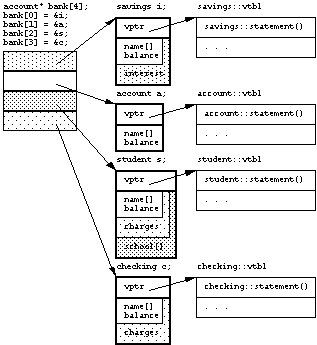
- Since static binding occurs at compile time, it is also called compile
time binding.
|
|
4
|
- As we saw in the previous lecture, a publicly derived class represents
an "is a" relationship.
- This means that whenever we need a direct or indirect base class object,
we can use a derived class object in its place because a derived class
object
- is a base class object.
|
|
5
|
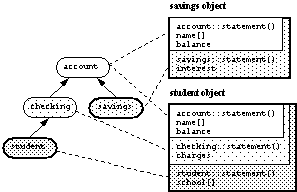
- Using this account class hierarchy, whenever we need an account object
we can use a checking, student, or savings object in its place.
- This is because every checking, student, and savings object contains an
account object.
- This is the essential characteristic of a hierarchy.
- Notice that it does not work the other way around.
- We cannot use an account object when we need a checking, student, or
savings object because an account object does not have the necessary
data members or member functions.
- If we attempt to do that a compile error will result.
|
|
6
|
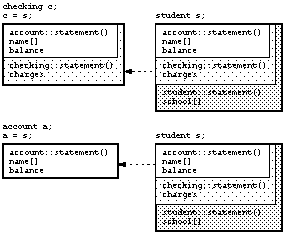
- student smith("Joe Smith", 5000, "UT");
- student s(smith); s.statement();
- checking c; c = s; c.statement();
- account a; a = s;
a.statement();
- When a student object is initialized/assigned to a checking or account
object, we lose the derived parts.
- When we use the statement member function, the function used is based on
the type of the object.
- For the checking object, the checking's statement member function is
used. For the account object, the account's statement member function is
used.
- These are statically bound by the compiler based on the type of the
object.
|
|
7
|
|
|
8
|
- Static binding guarantees that we will never associate a member function
of a derived class with an object of a direct or indirect base class.
- If that were to happen, the member function would attempt to access data
members that do not exist in the object. That is because a base class
object does not have an "is a" relationship with a derived
class object.
- Of course, we can go the other way around. That is, we can associate a
member function of a direct or indirect base class with an object of a
derived class as long as that member function is accessible (i.e.,
public).
- That is what inheritance is all about and it works because we have an
"is a" relationship.
|
|
9
|
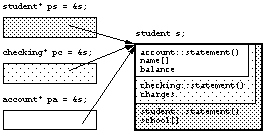
- We can assign pointers to derived class objects to point to base class
objects. We can also use derived class objects to initialize references
to base class objects.
- Using this account class hierarchy, whenever we need a pointer to an
account object, we can use a pointer to a checking, student, or savings
object. This is called upcasting even though no cast operation is
necessary.
- This is because every checking, student, and savings object contains an
account object. When we are pointing to a checking, student, or savings
object, we are also pointing to an account object.
- When we are pointing to an account object, we do not have access to a
checking, student, or savings objects.
|
|
10
|
- void print_account(account* p) { //pointer
- p->statement();
- }
- void print_account(account &r) { //reference
- r.statement();
- }
- int main() {
- student smith("Joe
Smith", 5000, "UT");
- student* ps = &smith;
ps->statement();
- checking* pc = &smith;
pc->statement();
- account* pa = &smith;
pa->statement();
- print_account(&smith);
//pass by pointer
- print_account(smith); //pass by reference
- }
|
|
11
|
- Notice that when we have a pointer to an account object and we
initialize or assign it to the address of a student or checking object,
that we are still actually pointing to the student or checking object.
- This is the only time in C++ when it is allowed to assign a pointer of
one type to another without an explicit cast operation.
- This is because a pointer
- to a derived class object
- points to a direct or
- indirect base class object
- as well!
|
|
12
|
- When we use the statement member function with our account pointer, the
actual member function used is the account's statement member function.
- This is because static binding is in effect.
- The member function bound by the compiler is based on the static type of
the pointer, not the actual or dynamic type of the object pointed to.
- Thus, even though the complete derived class object is there, static
binding prevents us from using the derived class' statement member
function.
|
|
13
|
- Dynamic binding occurs when a pointer or reference is associated with a
member function based on the dynamic type of the object.
- The dynamic type of an object is the type of the object actually pointed
or referred to rather than the static type of its pointer or reference.
- The member function that is dynamically bound must override a virtual
function declared in a direct or indirect base class.
- Since dynamic binding occurs at run time, it is also called run time
binding.
|
|
14
|
- Hiding alternative functions behind a common interface is called
polymorphism (a Greek term which means "many forms").
- Polymorphism allows multiple implementations of a member function to be
defined, each implementing different behavior.
- Member function overloading is one form of polymorphism. Member function
hiding is another.
- One of the most powerful forms of polymorphism is member function
overriding. With overriding, applications can be independent of derived
classes by using only base class member functions to perform operations
on derived classes.
|
|
15
|
- Within the object-oriented programming, function overriding takes
function hiding to the next level.
- Instead of deciding which function to bind to an object based on its
static type at compile time, the decision about which function to use is
based on its dynamic type and is postponed until run time.
- This is called pure polymorphism.
- Pure polymorphism defines an interface to one or more virtual member
functions in a base class that are overridden in derived classes.
|
|
16
|
- Overriding:
- Defining a function to be virtual in a base class and then implementing
that function in a derived class using exactly the same signature and
return type.
- The selection of which function to use depends on the dynamic type of
the object when accessed through a direct or indirect base class pointer
or reference at run time.
|
|
17
|
- Pure polymorphism requires four things to happen before it is in effect.
- First, we must have an inheritance hierarchy using public derivation.
- Second, we must declare a public member function to be virtual in either
a direct or indirect base class.
- Third, an overridden member function implemented in a derived class must
have exactly the same signature and return type as the virtual function
declaration.
- Fourth, the overridden function must be accessed through a direct or
indirect base class pointer or reference.
|
|
18
|
- There are two major differences between overloading and overriding.
- Overloading requires unique signatures whereas overriding requires the
same signature and return type.
- Second, overloading requires that each overloaded version of the
function be specified within the same scope whereas overriding requires
each overridden version be specified within the scope of each derived
class.
|
|
19
|
- There are two major differences between hiding and overriding.
- Hiding has no requirements on the signatures whereas overriding
requires exactly the same signature and return type.
- Second, hiding uses the static type of the object at compile time to
determine which member function to bind whereas overriding uses the
dynamic type of the object at run time to determine which member
function to bind.
|
|
20
|
- Specifying the keyword virtual for any base class member function
enables dynamic binding for that function.
- Any derived class can override that function by defining a function with
the same signature and return type.
- The keyword virtual does not need to be re-specified within the derived
class.
- Once a member function is declared to be virtual in a base class, all
functions with that name, signature, and return type in any derived
class remain virtual and can be overridden.
|
|
21
|
- Whenever we want a function to be dynamically bound, we should define
that function as virtual in a direct or indirect base class.
- By doing so, we are turning on the dynamic binding mechanism and
allowing member functions to be selected at run time based on the type
of object pointed or referred to.
- Virtual functions should be used when we want to provide member
functions in our base class that define an interface for application
programs to use.
- The actual implementation of the virtual functions is either provided by
the base class or is overridden and implemented as appropriate in
derived classes.
|
|
22
|
- Virtual functions cannot be static member functions.
- Second, the signature and return type must be the same for all
implementations of the virtual function.
- Third, while the function must be
defined as a virtual function within a direct or indirect base class, it
need not be defined in those derived classes where the inherited
behavior does not need to differ.
- And finally, the keyword virtual is only required within the base class
itself; derived class implementations of the overridden function do not
need to repeat the use of that keyword.
- Once a member function is declared to be virtual, it remains virtual for
all derived classes.
|
|
23
|
- If the signature of the overridden function is not the same as the
declaration of the virtual function, overriding does not occur and the
virtual function is simply hidden.
- In such cases, the virtual function invoked will be an inherited
function from a direct or indirect base class determined at compile
time.
- Or, if the function is invoked through an object rather than a pointer
or a reference, static binding will take place instead!
|
|
24
|
- //account.h (Ex1705)
- class account {
- public:
- account(const char*
="none", float=0);
- virtual void statement();
//virtual function
- private:
- char name[32];
- float balance;
- };
- //from main:
- student smith("Joe
Smith", 5000, "UT");
- student* ps = &smith;
ps->statement();
- checking* pc = &smith;
pc->statement();
- account* pa = &smith;
pa->statement();
- print_account(&smith);
//pass by pointer
- print_account(smith); //pass by reference
|
|
25
|
- The simple syntactic change of adding the virtual keyword to the
declaration of statement has significantly changed the output.
- In this example, the member function statement is a virtual function. It
is defined in the base class and is overridden in the derived classes.
- Notice that the signature and return types are the same. Also notice
that the keyword virtual only occurs in the base class' definition. It
is this declaration that enables dynamic binding.
- Finally, notice that we call the member function statement through a
pointer or reference.
|
|
26
|
- Dynamic binding allows a heterogeneous collection of objects to be
processed in a homogeneous way.
- The true benefit of dynamic binding is achieved when programs can
process different types of objects using a common interface.
- Applications use only virtual functions defined in the base class. The
application has no knowledge about any derived class, but can generate
statements appropriate for each type of account, depending on where base
class pointers reference.
- If additional types of accounts are later added to the class hierarchy,
the application can easily generate statements appropriate to those
accounts.
|
|
27
|
- class account {
- public:
- account(const char*
="none", float=0);
- virtual void statement();
//virtual function
- private:
- char name[32]; float balance;
- };
- void print_statements(account* bank[], int n) {
- for(int i=0; i<n; ++i) {
- bank[i]->statement(); cout
<<endl;
- }
- }
- //from main:
- savings i("Jim Jones",
500);
- account a("Empty
Account", 0);
- student s("Kyle
smith", 5000, "UT");
- checking c("Sue
Smith", 1000);
- account* bank[4]; bank[0] =
&i; bank[1] = &a;
- bank[2] = &s; bank[3] =
&c;
- print_statements(bank, 4);
|
|
28
|
- Dynamic binding delays until run time the binding of a member function
to a pointer or reference and requires that the compiler generate code
to select the correct member function at run time instead of compile
time.
- Some implementations create an array of member function pointers for all
virtual functions. Each derived class has its own unique array of
pointers. Functions that are inherited result in pointers to direct or
indirect base class member functions. Functions that are overridden
result in pointers to the derived class member functions. Each virtual
function has the same index in this table for each derived class. Only
one table exists per class that is shared by all objects of a class.
|
|
29
|
- When a member function is to be bound to a pointer or reference at run
time, the function accessed is obtained by selecting the correct member
function pointer out of the virtual table pointed to by the current
object's virtual pointer. It doesn't matter what the type of the object
is, its virtual pointer will point to the correct virtual table of
function pointers for that object.
- Note the additional costs of dynamic binding. With static binding, a
member function is directly bound to an object. With dynamic binding,
three additional levels of indirection may be needed to bind the correct
member function pointer with a pointer or reference to an object.
|
|
30
|
|
|
31
|
- This cost is not as bad as it first seems. Many compilers do this more
efficiently.
- Second, to “simulate” dynamic binding, the application would be
implemented significantly differently. Each derived class would have to
define a value to represent its type so that the application could query
the object at run time to determine what type it was pointing to. Then,
the application would have to downcast the pointer from an account
object to the correct type in order to access the correct derived class
member function. This would have to be done each time a derived class
member function needed to be accessed.
|
|
32
|
- Once dynamic binding is enabled, an overridden member function is bound
to a pointer or reference based on the type of the object pointed to.
- Dynamic binding is not in effect if an object is used instead of a
pointer or reference to an object.
- Dynamic binding is also not in effect if the member function is
qualified with a class name and the scope resolution operator. In this
case, the function bound to the pointer is the member function defined
by the qualifying class. (pa->account::statement(); )
- For example, if we assign the student object to an account object and
then invoke statement, static binding is in effect and the account
function is called: account a = smith;
|
|
33
|
- We can force application programs to always use pointers to base class
objects instead of using pointers to derived class objects or using
objects directly by making the overridden member functions protected or
private in the derived classes.
- This is a way to force applications to adhere to the defined interface
provided by the base class and to help ensure that dynamic binding will
be used.
- It causes compilation errors to result if the application attempts to
use static binding:
- student* ps = &smith;
- ps->statement(); //illegal access-protected member
- smith.statement(); //illegal
access-protected member
|
|
34
|
- class account {
- public:
- account(const char*
="none", float=0);
- virtual void statement();
- private:
- ...
- };
- class checking : public account {
- ...
- protected:
- void statement();
- };
- class student : public checking {
- ...
- protected:
- void statement();
- };
- app: student smith("Kyle
smith", 5000, "UT");
- account* pa = &smith;
- pa->statement(); //okay
|
|
35
|
- Dynamic binding can be used with overloaded operators as well as
conversion functions.
- All that is necessary is to declare the overloaded operators to be virtual
in a direct or indirect base class just like we do for regular member
functions.
- Functions and overloaded operators that cannot be implemented as members
can benefit from dynamic binding by invoking a virtual member function
that actually performs the required operation.
- When this is done, such functions are called virtual friends.
|
|
36
|
- In order to implement a virtual friend, we must implement a virtual
helper member function that performs the operation that we want and then
call it from the non-member function.
- We must be careful to declare the object for which we want polymorphic
behavior to be a pointer or a reference in the helper function.
- If the object is passed by value to the non-member function then dynamic
binding cannot be used because we have an object and not a pointer or
reference.
- It is best to make the helper functions protected or private in the base
class and in all derived classes and then the non-member function a
friend of the class.
|
|
37
|
- class account {
- friend std::ostream &operator<<(std::ostream
&,account&);
- protected:
- virtual void
statement(std::ostream &);
- ...
- };
- class checking : public account {
- ...
- protected:
- void statement(std::ostream
&); //helper fnct
- };
- class student : public checking {
- ...
- protected:
- void statement(std::ostream
&); //helper fnct
- };
|
|
38
|
- void account::statement(ostream &o) {
- o <<"Account
Statement" <<endl;
- o <<" name = " <<name
<<endl;
- o <<" balance = " <<balance
<<endl;
- }
- void checking::statement(ostream &o) {
- o <<"Checking
"; account::statement(o);
- o <<" charges = " <<charges
<<endl;
- }
- void student::statement(ostream &o) {
- o <<"Student
"; checking::statement(o);
- o <<" school = " <<school
<<endl;
- }
- ostream &operator<<(ostream &o, account &a) {
- a.statement(o); return (o);
- }
- app: student smith("Kyle smith", 5000, "UT");
- account &ra(smith); //reference
- account* pa(&smith);
//pointer
- cout <<ra
<<*pa; //both use the
“student
|
|
39
|
- Whenever we have virtual functions, we should always declare the
destructor to be virtual.
- Making the destructor virtual will ensure that the correct destructor
will be called for an object when pointers to direct or indirect base
classes are used.
- If the destructor is not declared to be virtual, then the destructor is
statically bound based on the type of pointer or reference and the
destructor for the actual object pointed to will not be called when the
object is deallocated.
- In the account class’ public section add:
- virtual ~account();
|
|
40
|
- When using virtual inheritance, virtual functions can be used in the
same way that we learned about previously.
- However, a class derived from two or more base classes that have a
virtual base class in common must override all virtual functions
declared in the common base class if it is overridden in more than one
of its direct base class branches.
- If virtual functions are not overridden in the derived class, it is
impossible to know which of the virtual functions to use. It would be
impossible to know which direct base class' virtual function to use!
This is because the virtual function is accessed from the common base
class pointer pointing to a derived class object.
|
|
41
|
- A class derived from two or more base classes that have a virtual base
class in common and where only one of the base classes has overridden a
virtual function from the common base class is allowed.
- In such situations, the derived class need not provide a definition for
this functions. The virtual function that is overridden in the one base
class will dominate and will be used.
- This is called the dominance rule.
|
|
42
|
|
|
43
|
- Run Time Type Identification (RTTI) uses type information stored in
objects by the compiler to determine at run time the actual type of an
object pointed or referred to.
- RTTI can only be used when at least one function has been declared to be
virtual in the class or in a direct or indirect base class.
- For the full benefits of dynamic binding, applications must write code
independent of the type of object being pointed or referred to.
- RTTI provides a way for client applications to determine the type of an
object without having to compromise their use of dynamic binding.
|
|
44
|
- A downcast operation is when a pointer to a direct or indirect base
class is converted to a pointer to a derived class.
- The static_cast operator syntax is
- static_cast<type*>(expr)
- where expr is an expression
pointing to a direct or indirect base class object and type is a derived
class.
- The result of the cast operation is that expr is converted to a pointer
to the specified type, converting the static type of one pointer into
another.
- As such, it depends on the programmer to ensure that the conversion is
correct. It is inherently unsafe because no run time type information is
used.
|
|
45
|
- The dynamic_cast operator relies on information stored in an object by
the compiler whenever a direct or indirect base class contains a virtual
function. This cast is used when downcasting to determine at run time if
the downcast is valid or not.
- The dynamic_cast operator syntax is
- dynamic_cast<type*>(expr)
- where expr is an expression
pointing to a direct or indirect base class object and type is a derived
class.
- expr is converted to a pointer of the specified type if the dynamic type
of the object pointed to is that type or is a type derived from that
type. Otherwise, the result of the cast operation is zero.
|
|
46
|
- student s;
- account* pa = &s;
- student* ps;
- ps = dynamic_cast<student*>(pa); //result is valid
- savings i;
- pa = &i;
- ps = dynamic_cast<student*>(pa); //result is a zero
- The dynamic_cast operator relies on the dynamic type information stored
in the object pointed to.
- Unlike static_cast, the dynamic_cast operator provides a safe downcast
mechanism by returning a zero pointer if the object pointed to is not in
the hierarchy of the type being cast to.
- If it is, a valid pointer is returned.
|
|
47
|
- The typeid operator relies on information stored in an object by the
compiler whenever a direct or indirect base class contains a virtual
function.
- This operator is used at run time to compare the type of an object with
the type of a known class.
- The typeid operator returns a reference to an object of type type_info.
This object contains a compiler dependent run time representation for a
particular type.
- This object can be compared with the type_info of known classes to
determine the type at run time.
- The header file <typeinfo> must be included to use the typeid
operator.
|
|
48
|
- student* ps = new student;
- if (typeid(*ps) == typeid(account))
- cout <<"*ps is an
account object" <<endl;
- if (typeid(*ps) == typeid(checking))
- cout <<"*ps is a
checking object" <<endl;
- if (typeid(*ps) == typeid(student))
- cout <<"*ps is a
student object" <<endl;
- if (typeid(*ps) == typeid(savings))
- cout <<"*ps is a
savings object" <<endl;
- The typeid operator is used to check the type of an object against a
known type whereas the dynamic_cast operator can be used to check the
type of an object against an entire hierarchy.
|
|
49
|
- The dynamic_cast operator is able to determine whether or not an object
is a member of a hierarchy. This can be useful to determine the
ancestors of a class. On the other hand, the typeid operator is only
able to determine if an object is of a particular type or not.
- It is best to avoid using RTTI because it inherently ties the
application to the types of objects that it is processing. Writing code
independent of the type being pointed or referred to provides cleaner
code that will be easier to maintain.
- Designs that need to use RTTI should act as a warning signal that a
better design using virtual functions may be possible.
|
|
50
|
|
|
51
|
- An abstract class is a class that can only be derived from; no objects
can be instantiated it.
- Its purpose is to define an interface and provide a common base class
for derived classes.
- A base class becomes an abstract class by making its constructor(s)
protected or by declaring a virtual function pure: virtual void statement()=0;
- Derived classes must implement all pure virtual functions. If a derived
class does not implement these functions, then it becomes an abstract
class as well.
- Abstract classes are not required to implement their pure virtual
functions.
|
|
52
|
- The purpose of declaring a function to be pure is to force the derived
classes to implement it.
- A virtual function is a contract with a derived class indicating the
name, signature, and return type for the function.
- Making the virtual function pure forces the contract to be fulfilled.
|
|
53
|
|
|
54
|
- Implicit conversions occur when mixed type expressions are evaluated or
when the actual arguments in a function call do not match the formal
arguments of the function prototype.
- First, the compiler tries to apply a trivial conversion.
- If there is no match, then the compiler attempts to apply a promotion.
- If there is no match, then the compiler attempts to apply a built-in
type conversion.
- If there is no match, then the compiler attempts to apply a user defined
type conversion.
- If there is no match, the compiler generates an error.
|
|
55
|
- To determine if a user defined type conversion is used, the compiler
checks if a conversion is defined for the type needed.
- If there is, then the compiler checks that the type matches the type
supplied or that the type supplied can be converted by applying one of
the built-in type promotions or conversions.
- Only one such built-in type promotion or conversion will be applied
before applying the user defined type conversion itself.
- Thus, at most one built-in type conversion and at most one user defined
type conversion will ever be implicitly applied when converting from one
type to another.
|
|
56
|
- Explicit conversions occur when the client explicitly invokes a cast
operation.
- Both implicit and explicit type conversions result in a temporary object
of the type being converted to.
- This temporary object is used in place of the original.
- The value of the original object is not affected.
- When considering execution efficiency, it is important to reduce or
minimize the creation of such temporaries.
- We recommend minimizing user defined conversions as much as possible by
avoiding mixed type expressions and by supplying arguments to functions
that exactly match the type required by the function prototypes.
|
|
57
|
- Constructors taking a single argument define a conversion from the type
of its argument to the type of its class.
- Such conversion functions can be used either implicitly or explicitly.
- When used implicitly, at most one implicit built-in promotion or
conversion will be applied to the argument of the constructor. name(char*
= "");
- //implicitly convert char* to
name
- name obj; obj = "sue smith";
|
|
58
|
- Remember, the lifetime of a temporary object is from the time it is
created until the end of the statement in which it was created.
- In the assignment statement, the temporary object is destroyed after the
temporary is assigned.
- As a formal argument (passed by value), the temporary object is
destroyed after the function is called.
- Therefore, not only are temporary objects formed (and the constructor
implicitly invoked) but the objects are also destroyed (and the
destructors are implicitly invoked).
|
|
59
|
- If we do not want a constructor taking a single argument to also define
an implicit conversion function, we can prevent that by preceding the
constructor declaration with the keyword explicit.
- The application is now required to provide explicit type casts in order
to convert a char* to a name object.
- Using a constructor as a conversion function allows us to convert an
object of some other type to an object of a class. They do not allow us
to define a conversion from a class to some other built-in type or
class.
- To do so, we must define a type conversion function.
|
|
60
|
- A conversion function allows us to define a conversion from an object of
a class to another built-in type.
- Conversion functions are also useful when we need to convert from an
object of our class to an object of a class that we do not have access
to or do not want to modify.
- When we do have access to the class and are willing to modify it, we can
always define a constructor taking a single argument of our class type
to perform the conversion.
- operator other_type();
|
|
61
|
- Notice that this conversion function has no return type. That is because
the return type is implicitly specified (other_type), since that is the
type we are converting to.
- The conversion function converts the current object into the new type
and returns the value.
- The conversion function can be called either implicitly or explicitly.
- The name of the conversion function must be a single identifier;
therefore, for types that are not a single identifier, a typedef must
first be used to create a single identifier.
|
|
62
|
- Notice that this conversion function has no return type. That is because
the return type is implicitly specified (other_type), since that is the
type we are converting to.
- The conversion function converts the current object into the new type
and returns the value.
- The name of the conversion function must be a single identifier;
therefore, for types that are not a single identifier, a typedef must
first be used. In the class:
- typedef const char* pchar;
//make single identifier
- operator pchar(); //conversion (name to char*)
- Implementing:
- name::operator pchar() {
//conversion function
- ...
- return array; //of type char * being returned
- }
|
|
63
|
- In order for the conversion function to be called explicitly when it is
a typedef name, that name must be in the global namespace and cannot be
hidden within the class.
- name obj("sue smith");
- const char* p;
- //Three examples of explicit
conversions:
- p = (pchar)obj;
- p = pchar(obj);
- p =
static_cast<pchar>(obj);
|
|
64
|
- With constructors as conversion functions and also conversion functions,
avoid mutual conversions.
- Many times type conversions are specified to minimize the number of
operators overloaded, especially for symmetric operators where there can
be multiple combinations of types for the two operands. It can reduce
the number of versions of an operator to a single, non-member.
- However, this can produce subtle changes in the way a program works. If
we were to add a string to char * user defined conversion function to
our string class, all uses of operator+ containing both char * and
string types would become ambiguous.
|
|
65
|
- Type conversions will not help when operators are members -- because a
member is required to have the first operand as an object of the class;
if it converted to some other type, the member function will not be
found as a possible candidate function and a compile error will result
or the wrong operator will be used (such as the built-in operators).
- Also, when user defined conversions to built-in types have been
specified, the predefined operators may end up being used even when we
use an operator with a user defined type for which an overloaded
operator exists! Overloaded operators are only invoked if at least one
of those operands is a user defined type.
|

 Notes
Notes