|
1
|
|
|
2
|
- Single Inheritance
- Introduction to Inheritance
- "Using" versus "Containing" Relationships
- "Containing" Relationships...through inheritance
- Inheritance and Derived Classes
- Creating a Derived Class...the syntax for single inheritance
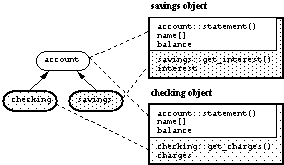
- Creating a Derived Class...constructors & destructors
- Constructor Initialization Lists
- What can be Inherited?
|
|
3
|
- Multiple and Virtual Inheritance
- Creating a Derived Class...the syntax for multiple inheritance
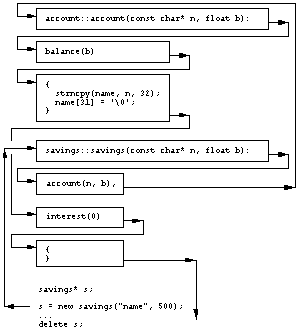
- Virtual Inheritance
|
|
4
|
- So far we have used classes and objects to represent generalized
abstractions.
- We learned how to enable these abstractions to be used in the same
contexts as built-in types.
- We learned what design tradeoffs to make to keep our abstractions as
efficient as possible.
- But, even though we were using objects, we were not using
object-oriented programming. We were simply one step closer by
understanding the syntax of classes and objects.
- Our abstractions were limited to stand alone classes.
|
|
5
|
- In the object-oriented programming paradigm, we begin to consider using
classes in conjunction with one another.
- We should no longer think about classes, or objects, in isolation from
one another.
- Instead of simply creating user defined data types, we create a
hierarchy of related and interdependent classes and objects, following
the natural structure of the problem.
- This is because object-oriented programming extends the concept of data
abstraction to apply across abstractions.
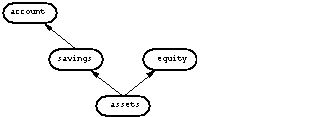
|
|
6
|
- Object-oriented programming can involve a natural way of thinking about
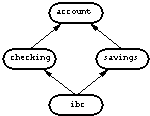
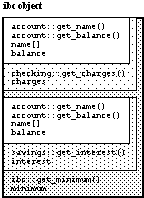
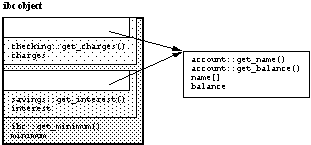
solutions.
- We organize information in ways that fit an application as it exists in
the real world.
- Unlike procedural abstraction, where we focus on what actions take place
(i.e., verbs), in object-oriented programming we focus on the component
parts (i.e., nouns) and the relationships between these parts.
- This means we must think about creating solutions in an entirely new
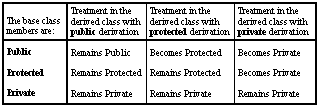
manner.
- We first consider nouns, then verbs.
|
|
7
|
- Object-oriented solutions are designed based on an inheritance hierarchy
which defines the relationships between classes, where one class shares
the structure and/or behavior of one or more classes.
- To provide this type of design requires that we understand how to
implement such relationships between objects. Therefore, our first step
in understanding object-oriented programming is to learn the syntax and
semantics of inheritance hierarchies.
- We will also learn how to extend abstractions with new functionality
even when the code for those abstractions is not available.
|
|
8
|
- By defining a class that is based on another class, using inheritance,
one class is a specialization of another.
- Such a class is said to be a derived class.
- The class it is derived from is a base class.
- The derived class inherits the base class' members.
- The benefit of this type of relationship is that it allows reuse of
existing code from the base class and allows us to focus on the new or
specialized behavior in the derived class.
- An existing program should not be aware that a new derived class has
been created if the specialized relationship is properly defined and
encapsulated.
|
|
9
|
- Every hierarchy has a root (e.g., base class) which has zero or more
children.
- Each child (e.g., derived class) is either a leaf or branches into
children of its own.
- Each class is inherently related to its parent, as well as to its
ancestors.
- In C++, the root of each hierarchy or sub-hierarchy is called a base
class.
- If the base class is the parent of the class in question, then it is a
direct base class. Otherwise, if it is an ancestor, then it is an
indirect base class.
|
|
10
|
|
|
11
|
- Because derived classes inherit the members of the base classes, one
class' design can be based on existing members from another class.
- Think of this as using building blocks.
- Instead of starting from scratch with each class that we design, we can
extend one class from another, reusing an existing class and reducing
the need to reinvent.
- New member functions can be added without modifying the base class
itself. And, a derived class can
change the inherited base class client interface by specifying data
members and member functions of the same name, hiding those inherited
from the direct or indirect base classes.
|
|
12
|
- Base classes are typically used to establish the common attributes and
behavior for an application and to all classes derived from it. .
- A derived class may then be used to refine and add to the base class and
represent specialized versions, with new or altered data/operations.
- The relationship between a derived class and its base class is often
called an "is a" relationship. This is because a derived class
"is a" base class.
- A derived class is everything the base class is and more, because it has
been extended or specialized. A derived class object can be used when a
base class object is needed.
|
|
13
|
- When a class is derived from one base class, it is called single
inheritance.
- In this figure, the base class is account.
- All classes are derived from this class, either directly or indirectly.
- checking is also a base class of the student class, since student is
derived from it.
- This makes account an indirect
base class of student.
- Notice how single inheritance
has a tree-like structure.
|
|
14
|
- To specify a derived class, we define the class as we learned but we
also add the base class' name as part of the derived class' definition.
- We don't need to alter the base classes to specify which classes are
derived from them.
- For public derivation where derived is the name of the derived class and
base is the name of the base class:
- class checking : public account //derivation
- {
- public:
- ...
- };
|
|
15
|
- We specify in the derived class which class is to be its parent. It is
this parent's members that are then inherited by the derived class.
- Saying class derived : public base establishes a single inheritance
hierarchy.
- The keyword public specifies that all public members of the base class
remain public in the derived class.
- This is called public derivation and is how we specify an "is
a" relationship between two classes.
|
|
16
|
- //base class
- class account {
- public:
- account();
- void statement();
- private:
- char name[32]; //account owner
- float balance; //account balance
- };
- //checking class derived from account
- class checking : public class account {
- public:
- checking();
- float get_charges();
- private:
- float charges; //charges for current month
- };
- //savings class derived from account
- class savings : public account {
- public:
- savings();
- float get_interest();
- private:
- float interest; //interest for
current month
- };
|
|
17
|
- Saying class checking : public account when defining the checking class
indicates that checking is a derived class.
- The keyword public tells the compiler that all public members of the
account class remain public in the checking class (i.e., public
derivation is taking place).
- The name account tells the compiler that the checking class is derived
from the account class.
- The account class is the direct base class for checking and savings.
|
|
18
|
- Objects of the checking and savings classes contain all of the members
of an account object and can be used where ever an account object can be
used.
|
|
19
|
- Even though inheritance hierarchies allow derived classes to inherit
members from their base classes, it does not mean that those members
will be accessible within a derived class.
- This is because members within a hierarchy have their own visibility.
- As we have seen, public members of a base class are visible and fully
accessible by classes derived from them. And, data and member functions
in the private section are only available to the class in which they are
defined. They are not accessible to any other class (with the exception
of friends).
|
|
20
|
- Derived classes do not have access to a base class' private data and
member functions, even though they are inherited.
- Even though memory is allocated for such data members, they may only be
accessed from members within the base class itself (or friends).
- This is important because giving any other class (besides a friend)
access to private information would compromise our ability to ensure
data hiding and encapsulation.
- Such a compromise would decrease the value of programming with objects.
|
|
21
|
- Previously, we recommended that data members be specified in the private
section.
- By following this guideline when designing hierarchies, all derived
classes would explicitly need to use the base class' public member
functions to access inherited data.
- This isn't practical when building classes that are intended to work in
harmony with one another. And, it reduces our ability to extend the
functionality of a given class in the future.
- By declaring members as protected, derived classes have access to base
class members while restricting access by client applications.
|
|
22
|
- A base class constructor is always invoked before a derived class
constructor in an inheritance hierarchy.
- This means that a derived class' constructor can assume that the base
class members have been initialized by the time it is executed.
- The body of a derived class constructor is executed last after the base
class and all indirect base class constructors within the hierarchy have
executed.
- But, when we have a derived class, we are not explicitly using the base
class' constructor. Instead, the base class’ constructor is implicitly
invoked by the derived class constructor that initializes the base class
members.
|
|
23
|
- When the base class has a default constructor, it is automatically
invoked when an object of the derived class is defined. This happens
whether or not the derived class constructor is a default constructor or
requires arguments.
- Supplying a default constructor in our base classes allows for the most
straightforward class design. And, supplying a default constructor in a
derived class makes it easier to use if classes are subsequently derived
from it.
|
|
24
|
- #include <iostream.h>
- class account {
- public:
- account();
- private:
- char name[32];
- float balance;
- };
- class checking : public account {
- public:
- checking();
- private:
- float charges;
- };
- class savings : public account {
- public:
- savings();
- private:
- float interest;
- };
|
|
25
|
- #include "account.h"
- account::account() : balance(0) {
- strncpy(name, "none",
32);
- name[31] = '\0';
- cout <<"account
constructor called" <<endl;
- }
- checking::checking() : charges(5) {
- cout <<"checking
constructor called" <<endl;
- }
- savings::savings() : interest(0) {
- cout <<"savings
constructor called" <<endl;
- }
- After the client saying: checking c;
- savings s;
- account constructor called
- checking constructor called
- account constructor called
- savings constructor called
|
|
26
|
- If a base class constructor expects an argument list, the derived class
must explicitly specify the base class constructor's arguments.
- If it doesn't, then the base class is expected to have a default
constructor, which is implicitly called.
- We explicitly specify the base class constructor's arguments by listing
the base class constructor in the derived class' initialization list
along with the actual arguments expected by the base class constructor.
- Client program: derived
obj(10,20);
- derived::derived(int i, int
j) {
- ...
|
|
27
|
- The arguments to the base class constructor can only consist of values
supplied as arguments to the derived class constructor, constants,
literals, global variables, or expressions made up from such values.
- We cannot use derived class data members as arguments to a base class
constructor nor can we invoke a member function of the derived class and
use its return value as one of the actual arguments
- because the derived class has not yet been initialized.
|
|
28
|
- class account {
- public:
- account(const char*
name="none", float amount=0);
- void statement();
- private:
- char name[32];
- float balance;
- };
- class checking : public account {
- public:
- checking(const char*
="none", float=0, float=5);
- float get_charges();
- private:
- float charges;
- };
- class savings : public account {
- public:
- savings(const char*
="none", float=0);
- float get_interest();
- private:
- float interest;
- };
|
|
29
|
- account::account(const char* n, float b) :
- balance(b) {
- strncpy(name, n, 32); name[31] =
'\0';
- }
- void account::statement() {
- cout <<"Account
Statement" <<endl;
- cout <<" name = " <<name
<<endl;
- cout <<" balance = " <<balance
<<endl;
- }
- checking::checking(const char* n, float b, float c) :
- account(n, b), charges(c) {}
- float checking::get_charges() {
- return (charges);
- }
- savings::savings(const char* n, float b) :
- account(n, b), interest(0) {}
- float savings::get_interest() {
- return (interest);
- }
- What values do the data members
have when the client says:
- checking c("Sue
Smith", 1000.0);
- savings s("Jim Jones",
500.0);
|
|
30
|
- The initialization list causes the base class constructor to be invoked
with the correct arguments!
- The order of the arguments for the base class is very important. They
must be listed in the same order as the base class constructor expects.
- If we had not included the base
class constructor in the initialization list of the derived class, then
the default base class constructor would be invoked.
- If no default base class constructor exists, then a compile error
results.
|
|
31
|
- Hiding applies the same for data members as it does for member
functions.
- Any base class data members that are public or protected are accessible
by the derived class.
- If the derived class defines data members of the same name (even though
the types may be different), any base class data members of that name
are hidden.
- It is the derived class data member that is accessed and not the hidden
base class member regardless of the data type.
|
|
32
|
- Constructors are invoked in the order of the base class first, then
derived class initializers, followed by the body of the derived class
constructor.
|
|
33
|
- Destructors are invoked at the end of the lifetime of an object.
- Destructors are invoked in the opposite order from which their
constructors are invoked.
- This means that the derived class destructor is invoked before its base
class destructor.
- If there are indirect base classes, this sequence continues until the
furthest base class destructor is invoked.
- A derived class destructor is guaranteed that its base class members are
still available for use.
|
|
34
|
|
|
35
|
- What happens when members in our hierarchy have the same name? Does
overloading occur? NO!
- Overloading means that we have unique signatures for the same named
function within the same scope. In a hierarchy, each class has its own
separate class scope. Overloading doesn't apply between classes.
- Instead, inheritance allows members in a base class to be hidden by
members of the same name in a derived class. By hiding base class
members the behavior of those functions can be redefined by the derived
class without changing the base class or affecting existing client
applications.
|
|
36
|
- Members are hidden anytime we specify a data member or a member function
in a derived class that has the same name as a member in a base class.
- A member function in a derived classes hides a member function in a base
class even if the signatures are different.
- When that member is accessed, either from a client of the derived class
or within the derived class itself, it is the derived member that is
used.
- If the argument list used by the client does not match any of the
functions defined within the derived class, a compile error will occur
even if a base class has a matching function.
|
|
37
|
- Even when members are hidden, they can still be used.
- If they are public or protected, they can be accessed from within a
derived class member function by using the class name and the scope
resolution operator.
- base_class_name::function_name()
- This gives us a means to reuse base class functionality in the
implementation of our derived classes.
- If the hidden members are public, they can be accessed from within a
client application by saying object.base_class_name::function_nme()
|
|
38
|
- Overloaded functions and overloaded operators are inherited in the same
manner as any other member function defined within the base class.
- If a derived class has the same named function or operator as in the
base class, then the base class overloaded function or overloaded
operator is hidden even if the signatures differ.
- However, the constructor, destructor, copy constructor, assignment
operator, address-of operator, and comma operator are not
overloaded. These base class
functions and overloaded operators are hidden and are not directly
accessible within the derived class or through an object of the derived
class.
|
|
39
|
- Neither the copy constructor nor the assignment operator are inherited.
- For a derived class, the implicitly supplied copy constructor and
assignment operator both implicitly call the base class copy constructor
and assignment operators before performing their memberwise copy
operations. This ensures that the base class portion of the derived
class is properly created or initialized before the derived class
portion.
- The base class copy constructor and assignment operator can be either
implicitly defined or explicitly implemented as part of the base class.
|
|
40
|
- When we explicitly define either a copy constructor or an assignment
operator in a derived class, we are responsible for ensuring that the
base class copy constructor and assignment operator are called. This is
because when we implement our own copy constructor or assignment
operator, the compiler no longer provides an implicit one and cannot
guarantee that the base class copy constructor or assignment op are
called.
- For the copy constructor, we specify the base class' copy constructor in
the initialization list of the derived class' copy constructor.
- student::student(const
student &s) : checking(s) {
- ...
- This works because a student object is a checking object; checking’s
constructor my be implicit or explicitly defined.
|
|
41
|
- For the assignment operator, this is not as simple. We must invoke the
base class' assignment operator from within the body of our derived
class' assignment op.
- To do so requires that we cast the current object (accessible by *this)
into a base class object as follows:
- student
&student::operator=(const student &s) {
- ... static_cast<checking
&>(*this) = s;
- The static_cast operator forces the type of the student object to be a
reference to a checking object. It causes the overloaded checking
assignment op. to be used for the object we are assigning to. When we
assign the student object to this reference, the overloaded checking
assignment operator is called with the checking part of the student
object.
|
|
42
|
- Why is the cast important?
- If we didn't use a cast to change the type of the object we are
assigning to,
- we would then have a recursive call to the overloaded student
assignment operator!
- In the following example, it we had not called the checking class' copy
constructor and assignment operator from the student class copy
constructor and assignment operator, we would correctly copy the student
part, but not the checking and account parts.
|
|
43
|
- class account {
- public:
- account(const char*
="none", float=0);
- account(const account
&); ~account();
- account &operator=(const
account &);
- void statement();
- private: char* name; float
balance;
- };
- class checking : public account {
- public:
- checking(const char*
="none", float=0, float=5);
- void statement();
- private: float charges;
- };
- class student : public checking {
- public:
- student(const char*
="none", float=0, const char* ="");
- student(const student
&); ~student();
- student &operator=(const
student &);
- void statement();
- private:
- char* school;
- };
|
|
44
|
- account::account(const char* n, float b) : balance(b) {
- name = new char[strlen(n) + 1];
- strcpy(name, n);
- }
- account::account(const account &a) {
- balance = a.balance;
- name = new char[strlen(a.name) +
1];
- strcpy(name, a.name);
- cout <<"account copy
constructor called" <<endl;
- }
- account::~account() { delete[] name; }
- account &account::operator=(const account &a) {
- if (this != &a) {
- balance = a.balance;
- delete[] name;
- name = new char[strlen(a.name)
+ 1];
- strcpy(name, a.name);
- }
- cout <<"account
assignment op called" <<endl;
- return(*this);
- }
|
|
45
|
- student::student(const student &s) :
- checking(s) { //call copy ctor
- school = new
char[strlen(s.school) + 1];
- strcpy(school, s.school);
- cout <<"student copy
constructor called" <<endl;
- }
- student::~student() {
- delete[] school;
- }
- student &student::operator=(const student &s) {
- if (this != &s) {
- static_cast<checking
&>(*this) = s; //call assign op
- delete[] school;
- school = new
char[strlen(s.school) + 1];
- strcpy(school, s.school);
- }
- cout <<"student
assignment op called" <<endl;
- return(*this);
- }
|
|
46
|
- A using declaration can bring any hidden public or protected base class
member into the scope of the derived class.
- These members act as overloaded members of the derived class.
- However, such members remain hidden in situations where the argument
list is the same as the same named member in the derived class.
- In the following example, the using declaration makes the function
taking the double accessible to clients of the derived class. But, the
function taking the int is still hidden in the derived class by
declaring a derived class member function that has the same signature.
|
|
47
|
- class base {
- public:
- void fun(int) {
- cout
<<"base::fun(int)" <<endl;
- }
- void fun(double) {
- cout
<<"base::fun(double)" <<endl;
- }
- };
- class derived : public base {
- public:
- using base::fun; //fun(int) & fun(double) now in
scope
- void fun(int) { //hides fun(int) brought into scope
- cout
<<"derived::fun(int)" <<endl;
- }
- void fun(char*) { //defines
new fun(char*)
- cout
<<"derived::fun(char*)" <<endl;
- }
- };
|
|
48
|
|
|
49
|
- With multiple inheritance, a derived class can inherit from more than
one base class
- In situations where a new class has attributes and behavior in common
with more than one class, we may choose to implement a multiple
inheritance hierarchy.
- There are two disadvantages to creating multiple inheritance
hierarchies. First, it is harder than single inheritance to implement
and maintain.
- Second, it is more restrictive than single inheritance. We recommend its
use only after looking at all options.
- Multiple inheritance provides the simplicity of inheriting behavior from
more than one base class and minimizes reimplementation of existing
behavior.
|
|
50
|
- To specify a derived class when there is more than one base class, we
add each direct base class name as part of the derived class' header.
This is the same as with single inheritance, except there is a comma
separated list of base classes.
- class assets : public savings, public equity {
- public:
- ...
- };
- The definition cannot be cyclical.
- A direct base class cannot be specified
- more than once for any derived
class.
|
|
51
|
- All base class constructors are always implicitly invoked prior to the
derived class' constructor.
- The order in which the constructors are invoked is based on the order of
the base class declarations in the derived class. class assets : public
savings, public equity means that the savings constructor is invoked
first followed by the equity constructor. Thus, the order of constructor
invokation for these classes is savings, equity, and assets.
- As long as each base class has a default constructor, the derived class
will automatically invoke them. If not, an explicit call to a base class
constructor w/ arguments must be in the initialization list of the
derived class.
|
|
52
|
- If one of the base class constructors expects an argument list, the
derived class constructor must supply the actual arguments expected by
the base class constructor in its initialization list.
- For example, if the savings and equity constructors expect arguments,
the assets class constructor must provide them as follows:
- class assets : public savings, public equity {
- public:
- assets(const char* n, float s)
:
- savings(n, s),
- equity(n, e) {
- }
- ...
|
|
53
|
- When members of two different base classes have the same name, an
ambiguity results when used.
- This ambiguity cannot be resolved by the compiler, but must be resolved
at the time the access is made either by the class or by the client.
- The ambiguity can be resolved by using the base class name and the scope
resolution operator when accessing the ambiguous member (e.g.,
savings::get_name). This is the only way such an ambiguity can be
resolved within the derived class when accessing the base class member.
|
|
54
|
- Members in a base class are hidden anytime we specify a data member or a
member function in a derived class that has the same name as a member in
one of the base classes. When that member is accessed, either from a
client of the derived class or within the derived class itself, it is
the derived class member that is used.
- To avoid problems with ambiguous resolutions, if there are members with
the same name in the base classes, then we should make a rule to hide
those members with a member of the same name in our derived class. This
is a simple rule to follow and will avoid problems of ambiguity for
clients of our classes.
|
|
55
|
- Every object of class checking is comprised of both checking and account
members and every object of class savings is comprised of both savings
and account members.
- Since an object of class ibc inherits from both checking and savings,
there are two implicit objects of class account contained in an ibc
object.
|
|
56
|
- Virtual inheritance is an extension of multiple inheritance.
- Its objective is to allow efficient use of memory and elimination of
duplicate state spaces when designing inheritance hierarchies that share
a common base class.
- The only time one might use virtual inheritance within a single
inheritance hierarchy is when we can foresee future extensions that may
result in a derived class sharing a common base class.
|
|
57
|
- It allows the direct base classes of a derived class to be derived from
a common direct or indirect base class without duplicating data members
of the base class.
- An object of class ibc has memory allocated for all of the data members
of class ibc, checking, savings, but just one account.
|
|
58
|
- A virtual base class is specified in our class derivation lists, with
the keyword virtual before each common base class name as part of the
base class header.
- class common_base {...};
- class base_1 : virtual public
common_base {...};
- class base_2 : virtual public
common_base {...};
- class derived : public base_1,
public base_2 {...};
- Each path leading from the derived class to the common base class must
specify that the common base class is a virtual base class.
- If the common base class is not a direct base class of the derived
class, then the derived class does not need to use the keyword virtual
in the derivation list
|
|
59
|
- A virtual base class is specified in our class derivation lists, with
the keyword virtual before each common base class name as part of the
base class header.
- class common_base {...};
- class base_1 : virtual public
common_base {...};
- class base_2 : virtual public
common_base {...};
- class derived : public base_1,
public base_2 {...};
- Each path leading from the derived class to the common base class must
specify that the common base class is a virtual base class.
- If the common base class is not a direct base class of the derived
class, then the derived class does not need to use the keyword virtual
in the derivation list
|
|
60
|
- If a path exists in the multiple inheritance hierarchy that derives the
common base class as not virtual (i.e., leaving out the keyword
virtual), then this turns off virtual inheritance for that path and more
than one instance of the common_base will be formed.
- Virtual base classes are constructed before any of their derived
classes. They are also constructed before any non virtual base classes.
And, destructors are still invoked in the reverse order of constructors.
- Any direct or indirect base classes that have initialization lists that
invoke the virtual base class constructor are ignored.
|
|
61
|
- Always supply default constructors with virtual base classes. This will
avoid problems when initializing virtual base class members. If a
virtual base class has arguments, then we must expect the most derived
class to have full knowledge of the indirect base class constructor.
- Arguments specified for virtual base class constructors must come from
the derived class that is actually creating an object.
- Virtual base class constructor invokations from intermediate base
classes are ignored.
|
|
62
|
- There are two other forms of derivation that are possible: protected
derivation and private derivation.
- If we are interested in extending the client interface for one of the
direct base classes, then it should be derived as public.
- If we are interested in replacing the client interface but allowing
future derivation, then it should be derived as protected.
- If we want no future derivation, then it should be derived as private.
|
|
63
|
- class derived: public base_1,
- private base_2
{...};
- Remember that regardless of the type of derivation, private members are always private to
the class and are never available to any derived classes except for
friends of the class.
|

 Notes
Notes