Environmental Cleanup and Restoration
CE/ESR 410/510
OPTIONS FOR DEALING WITH CONTAMINATED SEDIM,ENTS
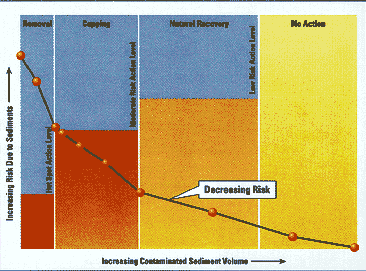
Sequential Risk Mitigation
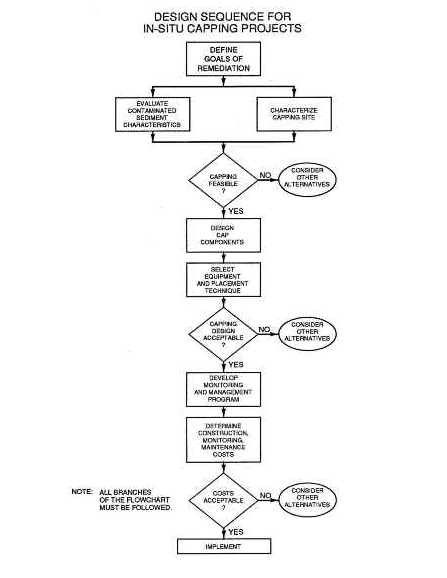
Sequential risk mitigation approaches the remediation of contaminated sediments in three phases designed to:
Natural Recovery
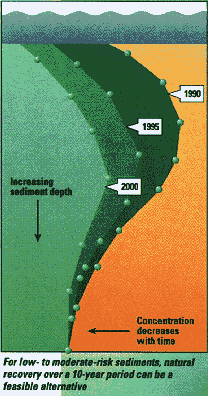
Natural recovery, the reduction of contaminant concentrations through natural processes, is based on the practical observation that overall ecosystem recovery appears to be largely a function of time. Sediment decomposition and the mixing of new and old sediments by bottom-dwelling organisms contribute to reduced contaminant concentrations. The physical behavior of contaminants is also a factor; in many regions, the average residence time of chemicals in the upper mixed sediment layer is 10 years. Residence times in water are relatively short and range from as little as two weeks up to one year, depending on the chemicals involved. Knowledge of these processes, sediment decomposition, sediment mixing by bottom-dwelling organisms, and chemical residence time, is critical in the development of appropriate ecosystem recovery and waste management strategies
Confined Disposal
The purpose of confined disposal is to isolate contaminated material and prevent contaminant release. Contaminated sediments can be confined in aquatic, nearshore, and upland environments.
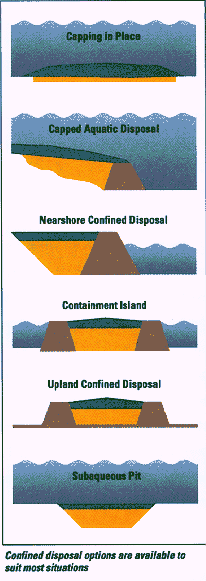
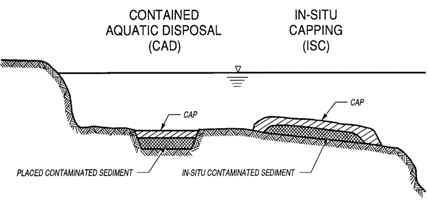
Dredging is clearly necessary for moving contaminated sediments to an upland site, and also may be required for "gathering" contaminated sediments for in-water disposal. However, in many cases it is possible to avoid dredging by using confined aquatic disposal at the places where sediments are contaminated.
With confined aquatic disposals (CAD), the most important factors in site design are the physical and chemical quality of the cap, the depth of water, and topography. In addition, water currents must be considered to assure long-term stability of the cap. At nearshore disposal sites, contaminated material is placed in a shallow environment created by excavating a portion of the shore or by filling an existing indentation; this is then surrounded by a berm or dike to prevent direct contact with waterways. To permit future site uses, the final grade is typically raised above high tide.
Upland disposal sites usually feature liners, caps, leachate collection and treatment systems, and surface runoff collection systems. Upland disposal is complicated, both because the level of contamination influences the rigor of the design and because regulations written for materials that originate on land often do not apply to dredged materials.
Treatment
Treatment of contaminated sediments can encompass any of the following technologies:
Source Control
Source control is also crucial from a technical perspective. Clearly, sediment remediation works only if ongoing pollution of waterways is prevented. A careful study of sources--which may be as diverse as storm drains, effluent discharges, spills, airborne fallout, and groundwater discharge–is part of the overall sediment quality assessment. Is is then possible to recommend enhancements to existing policies to ensure that mitigation efforts are effective.